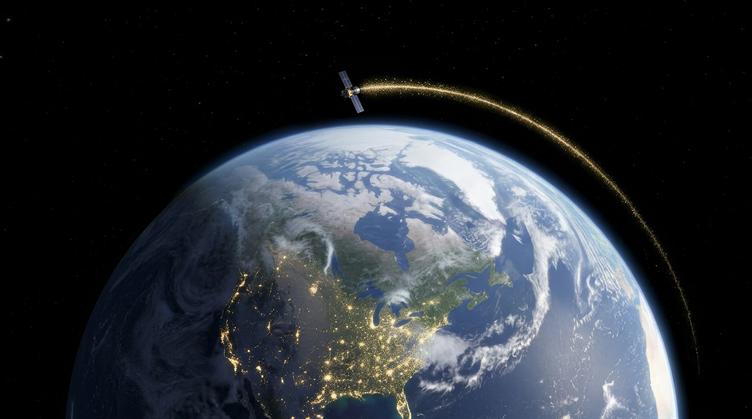
Nvidia is entering the space computing business by bringing AI to orbital data centers (ODCs), geospatial intelligence and autonomous space operations.
Nvidia’s Space-1 Vera Rubin module is part of Nvidia’s space platform that offers up to 25 times more AI compute to allow for space-based inferencing. The compute platforms are designed to enable AI applications to operate from ground to space and space-to-space while maintaining support for complex mission profiles.
Nvidia said its data center platforms, like the RTX Pro 6000 Blackwell Server Edition GPU, deliver on-demand ground processing for geospatial intelligence, delivering up to 100 times faster performance against legacy CPU-based batch systems.
“Space computing, the final frontier, has arrived,” said Jensen Huang, founder and CEO of Nvidia. “As we deploy satellite constellations and explore deeper into space, intelligence must live wherever data is generated. AI processing across space and ground systems enables real-time sensing, decision-making and autonomy, transforming orbital data centers into instruments of discovery and spacecraft into self-navigating systems. With our partners, we’re extending Nvidia beyond our planet — boldly taking intelligence where it’s never gone before.”
Currently, space-based companies using Nvidia for accelerated computing include:
- Aetherflux
- Axiom Space
- Kepler Communications
- Planet
- Sophia Space
- Starcloud
Nvidia said the Space-1 Vera Rubin modules can of bring hyperscale AI capability into orbital platforms for on-orbit analytics, autonomous scientific discovery and rapid insight generation by providing the performance and memory needed to process massive data streams from space-based instruments in real time.
“At Aetherflux, we’re pioneering a new paradigm for power and compute in space,” said Baiju Bhatt, founder and CEO of Aetherflux. “Nvidia Space-1 Vera Rubin Module delivers high-performance, energy-efficient AI at the edge in orbit, powered by solar energy. This enables autonomous operations and mission-critical services, and unlocks scalable, space-based AI infrastructure beyond Earth.”
