

In a move more reminiscent of state-backed industrial policy than American free market tradition, the U.S. Department of Commerce announced nine letters of intent totaling $2.013 billion in CHIPS and Science Act funding for quantum computing companies and chip manufacturers.
The biggest catch being that the government takes an equity stake in every single one of them.
While this practice of governments taking equity stakes in strategic technology firms is not new, it is, however, new to the U.S. China has long been a stakeholder and provided funding for its domestic technology companies. Europe, France and Germany have all taken direct stakes in companies deemed as critical to national interests. The EU has even gone so far as to lean heavily on public co-investment. Japan, too, has used public funding to steer semiconductor development.
What has historically separated U.S. policy from these models is a market-driven investment philosophy. But in August of 2025, the U.S. turned the CHIPS and Science Act funding it gave to Intel Corp. into a 10% stake in the company. This was a signal that the government was shifting toward state-driven tech investments. Nine companies in a single day suggest the government has gone all-in.
Like a venture capital firm building a diversified portfolio, the government is spreading bets across every major quantum modality — superconducting, photonic, trapped ion, neutral atom, silicon spin — rather than picking a single winner.
The funding will support quantum companies including two quantum foundry companies — IBM and GlobalFoundries — and seven quantum computing companies. The goal is to accelerate the development of utility scale, fault-tolerant quantum computers.
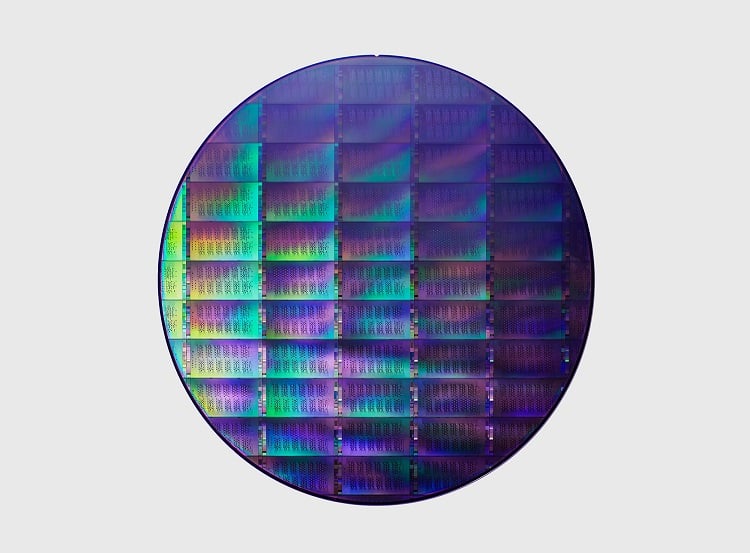 A 300 mm quantum wafer. Anderon is a new quantum foundry aiming to be the world’s leader in quantum computing chips after new investments from the government and IBM. Source: IBM
IBM’s quantum foundry — Anderon
Perhaps the biggest news coming from the $2 billion investment spree comes from IBM’s establishment of an American quantum chip foundry to help grow the quantum ecosystem.
Called Anderon, the fab is billed as America’s first pure-play quantum foundry and will position the U.S. to manufacture most of the world’s quantum wafers, IBM said.
IBM has signed a letter of intent to receive $1 billion in CHIPS incentives provided by the U.S. DoC, but IBM is also providing an additional $1 billion in cash to the Anderon project.
Headquartered in Albany, New York, as a standalone company, Anderon will operate a state-of-the-art 300 mm quantum wafer foundry with the goal of delivering the world’s first large-scale, fault-tolerant quantum computer by 2029 for commercial clients.
IBM said Anderon will serve as the anchor for a national ecosystem for quantum wafer manufacturing. The company will use its fabrication tools and engineering talent to help Anderon build a secure, U.S.-based supply of quantum wafers for multiple hardware vendors. Anderon will first support wafer fabrication or superconducting qubit and support electronic wafers. It will then expand to other quantum modalities.
Other funding
GlobalFoundries was the second foundry to receive funding to develop a domestic manufacturing capacity for the quantum sector. The company will receive $375 million and has eight different companies already signed on to build its quantum ecosystem including Nvidia, Microsoft and Google.
The other seven companies to receive potential capital toward quantum R&D and development include:
- Atom Computing — $100 million to address challenges for neutral-atom quantum computing.
- Diraq — $38 million to develop and scale quantum logic units.
- D-Wave — $100 million for advancements in annealing and gate-model superconducting quantum systems.
- Infleqtion — $100 million to develop integration requirements for large-scale neutral-atom-based quantum computers and architectures.
- PsiQuantum — $100 million for key photonic quantum computing challenges.
- Quantinuum — $100 million to address scaling of fault-tolerant trapped-ion-based quantum computers.
- Rigetti — $100 million to address challenges on scaling superconducting quantum computing technologies and architectures.
While GF said the U.S. government will take a 1% stake in the company after the funding, the other companies did not reveal how much ownership the U.S. government will take in them. However, Anderon said it would be a “minority, non-controlling equity stake.”
Regardless, the U.S. government has entered into previously uncharted territory and, given recent moves, it's likely this won't be the last investment it takes.
