Precision of rotational and linear measurement underpins motion control systems, and optical encoders are a mainstay in delivering this. Converting mechanical motion into digital signals enables encoders to deliver real-time and precise feedback for linear and rotational position, and by integration speed and acceleration.
Throughout robotics and CNC machines, aerospace and automotive industries, medical and manufacturing, encoders facilitate astonishing precision.
This article will explore how optical encoders revolutionize motion control systems. It covers operating principles, benefits and the routes to precision, ultimately driving innovation in automation and control technologies.
Encoder technologies
Optical encoders exist in four basic formats, each with many variants. These have developed to be suited to divergent applications:
Incremental encoders: These are the simplest type, and they function by generating an angular change pulse as a fine gate opens and closes an optical path. These allow step control that is proportional to the gearing of the drive and the angular finesse of the gate. They provide directional awareness by operating two gates that are slightly out of phase, so the pulse order defines the direction of motion.
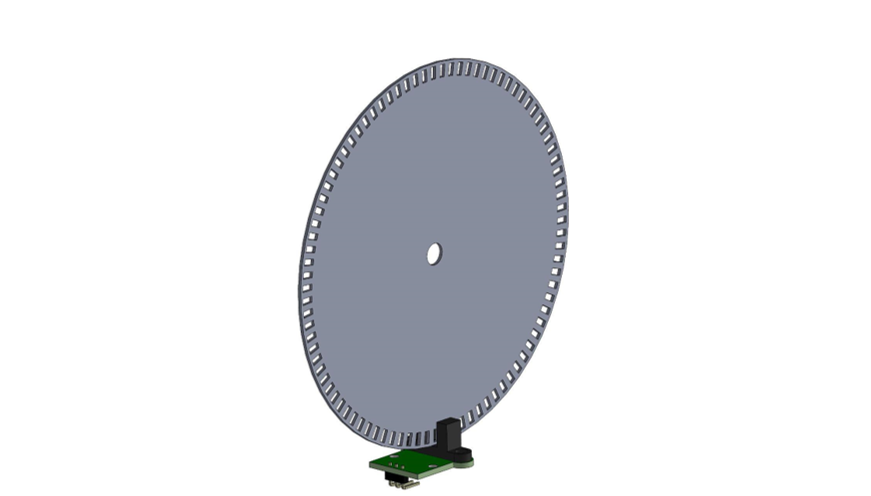 This image shows the most basic type of incremental encoder, producing a pulse every 2° each time an occlusion edge (light to dark or dark to light) passes between light sender and receiver. Source: Original image
 The same basic setup with 2 rows of occlusions that are offset allows a sense of direction in the encoder application. This also increases the angular resolution to 1°. Source: Original image
Absolute encoders: These provide unique position values, ensuring accurate data even after power loss or shutdown. This is achieved by using multiple gate rings in a setup that can give a bit-precision that results directly from the number of nested encoder rings. This nesting can be either axial (along the shaft) or radial (spaced diametrically). These devices are necessary when both rate and startpoint awareness are required, such as in robotics that must be able to restart with a full awareness of prior position.
Linear encoders: Used for measuring straight-line motion, linear encoders work on a similar principle to rotary incremental or absolute encoders, but detect linear displacement, making them requisite for CNC machines and precision stages.
Optical grating encoders: These types can be either linear or rotary, operating with greater accuracy than other types by exploiting a cyclic interference pattern between two gratings, with either multiple sensors along a reader-length or a level-sensitive optical detector that can interpolate position with accuracy greater than the grating spacing, by assessing light levels rather than simple digital (presence or absence of light) detection.
The role of encoders in precision motion control
The two fundamental types of optical encoders — linear and rotary — are at the heart of most precision motion control systems, allowing positional awareness in automated systems. They convert mechanical motion into digital signals that tell the control system that its instructed position (or speed or acceleration) has been achieved. This enables automated systems to perform positioning tasks with both high accuracy and excellent repeatability.
Optical encoders are widely used for their superior resolution and reliability. By detecting light patterns through the stationary and moving encoder elements, they deliver fine-grained feedback necessary for precise control in high-performance applications.
In virtually all position control and many speed/acceleration control systems, encoders provide reliable position data, and enhance the performance of motion control systems, compared with any other encoder technology.
Selecting the right encoder
Choosing the appropriate optical encoder type and construction depends on several factors, including the specific application, required accuracy and environmental conditions. Here's a guide to help select the right type:
Incremental versus absolute
Incremental encoders are suited to applications that track velocity or direction, where high accuracy is not required, such as conveyor systems or basic automation tasks where ‘arrival’ is detected by other methods.
Absolute encoders are suited for applications that demand continuous, precise position feedback, even after a power-down, such as robotics, CNC machines, and any equipment where maintaining exact positioning is a required function.
Rotary versus linear
Rotary encoders measure angular motion or displacement and are needed for rotating shafts in motors, robotic joints or other rotating positioning systems.
Linear encoders measure straight-line motion and are ideal for systems requiring precise linear displacement, such as milling machines or precision stages.
NOTE: The choice between linear and rotary types is not clear-cut — most linear systems have rotary drives, so both options are feasible. The difference arises by displacement from the point of application. Higher precision results from less remote measurement, allowing better handling of any drive hysteresis.
Environmental considerations
For harsh environments (dust, oil or vibration), choose an optical encoder with protective housing or consider magnetic encoders, which may offer better durability in such conditions. Typically, remote sensing via rotary encoder is both removed from the contaminant sources and simpler to seal, as a rotating shaft seal is all that is required and these are more reliable and simpler than linear slide seals.
Resolution and accuracy
High-resolution encoders (down to sub-micron and seconds of arc sensitivity) are essential for applications requiring extreme precision, like semiconductor manufacturing or medical devices. This is only achievable by very complex (high byte number) absolute encoders or very high-grade optical grating devices
Implementing encoders in precision motion systems
To effectively implement an encoder in any application, a few key factors must be considered:
They must be integrated with the system's controller for the real-time feedback to be useful. This requires either direct compatibility between the encoder output and the controller input, or an intermediary device that converts (such as a digital to analog converter, data buffer).
Precise installation is essential for maintaining accuracy, so devices must be securely mounted and incapable of misalignment, sympathetic vibration or other disturbances that would adversely influence accuracy.
The resolution and capability of the encoder must be appropriate to the demand of the application. High-resolution encoders suit applications requiring fine control, while signal conditioning may be necessary to reduce noise — however, excess resolution is not a barrier and can allow some futureproofing.
After installation and regularly during normal maintenance, calibrating the encoder ensures it provides reliably accurate position feedback is imperative. Routine testing and maintenance will prevent drift.
The evolution of encoder technology
Optical encoders have undergone huge advancements since their first introduction as rotary pulse counters. They have evolved to meet the steadily incrementing demands for precision, motion speed and reliability.
With the development of advanced optics and digital electronics, modern encoders now provide much higher resolution and reliability. First came incremental encoders to track relative motion, later absolute encoders provided unique and reliable position data, serving applications that require precise and continuous spatial awareness.
Ongoing innovations include miniaturization, which allows encoders to be integrated into compact systems like medical devices and drones, and multi-turn incremental encoders that can track motion over multiple revolutions with absolute (as opposed to incremental/counted) position.
Improvements in optical grating technologies — in both grating manufacture and sensing device scale — have resulted in sub-micron accuracy for the highest precision applications like semiconductor manufacturing.
The integration of optical encoders with AI and ML driven systems suggests increasing advancements in precision, adaptability and real-time feedback, by system learning and interpolation. This will continue pushing the boundaries of motion control in automation and robotics.
Real-world applications of optical encoders
Optical encoders are deeply intrinsic to many industries wherever precise motion control and feedback are required. These range from millimeter levels of accuracy to a few Angstroms.
Robotics: Optical encoders provide real-time position feedback, allowing precise control of position and speed in robots of all classes, from domestic helper cobots to large scale assembly and welding robots, and surface-mount technology pick-and-place equipment.
CNC machining: In CNC machines, encoders ensure accurate positioning of cutting tools and workpieces. The entire purpose in CNC machining is precision and repeatability, combined with the ability to adapt in real-time to changes in machining conditions. High-resolution optical encoders enable precise cuts and ensure the repeatability required in manufacturing complex parts. Only relatively low-grade equipment relies on stepper motors for drive without positional detection.
Medical devices: Optical encoders are necessary in robotic surgical systems and medical imaging equipment, such as MRI and CT scanners, where absolute and precise positioning are critical for patient safety, precise function and meaningful diagnostic outcomes.
Aerospace and aviation: In aircraft control systems and satellite positioning, optical encoders provide the extreme precision required for navigation, control surfaces, and space exploration technology.
Semiconductor manufacturing: Precision is central to semiconductor production, where optical encoders guide tools and positioning systems with the sub-micron accuracy demanded by the ever-increasing resolution of the feature size imprinted on wafers and required for inspection.
Conclusion
Linear and rotary optical encoders are invisible to most machine users, but fundamental in ensuring precise motion control across all sectors of industry and human endeavor — from manufacturing equipment to CNC machines, from spacecraft to food production.
Their ability to provide highly selectable levels of real-time feedback on position, speed, and direction delivers accuracy and adaptive control in simple and complex applications. Incremental or absolute, linear or rotary, all classes of encoder are purposed to meet specific needs, suited to different operational environments and situational awareness needs.
As technology advances, optical encoders evolve for higher resolution and reliability, ensuring their central position in innovation.
