
A mouse-shaped robot designed for inspecting the collider infrastructure at CERN has been developed by a team of engineers from the U.K. Atomic Energy Authority (UKAEA) robotics center, RACE (Remote Applications in Challenging Environments).
According to its developers, the “PipelNEER” is a small inspection device capable of inspecting beamline pipes in the Large Hadron Collider (LHC), otherwise known as the world’s most powerful particle accelerator, at CERN. The PipelNEER uses artificial intelligence (AI) and sensors to detect faults and identify the locations of issues.
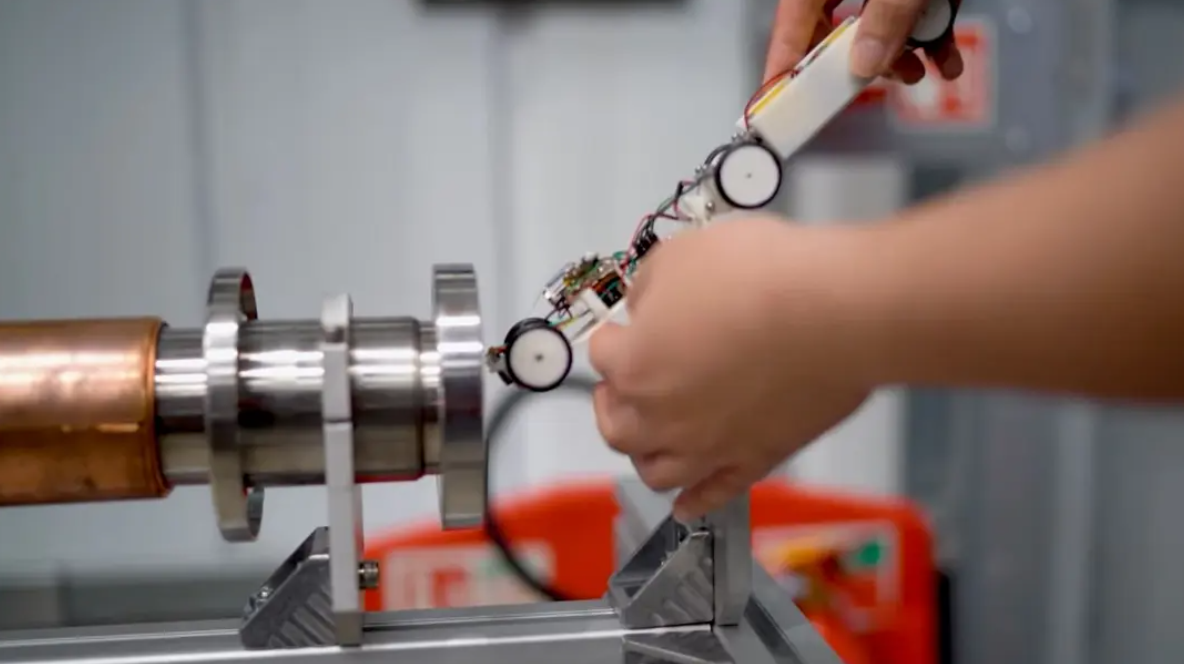 Source: UKAEA
The team explained that beamline pipes operate deep within complex infrastructure at extremely cold temperatures and ultra-high vacuum, making maintenance difficult because equipment must be dismantled to reach them. Such harsh conditions reportedly cause the pipes to expand and contract, and, over time, this thermal cycling can bend and warp small components — specifically the thin radio-frequency contacts within the collider’s approximately 2,000 plug-in modules (PIMs) — potentially impacting system reliability and requiring regular inspection.
As such, the team developed the 20 cm long PipelNEER to autonomously travel through beamline spaces as wide as 3.7 cm.
Unlike the current line-up of pipe-inspection tools, the PipeINEER can travel up to 6 km on a single battery charge. Further, it captures high-resolution images of each PIM as it moves through the beamline and analyzes those images using AI trained on real imagery from the LHC to identify possible abnormalities.
In the event that the PipeINEER detects a fault, it will automatically return to its starting point and report the exact location of the issue, thereby enabling engineers to concentrate on specific sections of the 17-mile long collider and avoiding having to dismantle long stretches of pipe and inspecting them manually using endoscopes.
For more on the PipelNEER, watch the accompanying video that appears courtesy of the UKAEA.
