
Modern warehouse logistics struggle to balance automated efficiency with operational unpredictability. While physical hardware has advanced rapidly, the software coordination of complex tasks like order picking remains a bottleneck. Traditional warehouse management systems typically rely on static rules, such as fixed paths or simple first-in, first-out sequences, to manage throughput. These methods are reliable in stable environments but often lose efficiency when faced with high variability. Fluctuating order volumes and real-time aisle congestion can quickly render static plans obsolete.
The limitations of these rigid rules have driven interest in adaptive control systems using reinforcement learning. In this framework, an autonomous agent treats the warehouse as a dynamic environment to be navigated. By processing continuous feedback from the floor, the model can adjust routing and picking priorities based on live variables like equipment location, remaining capacity and order density. While this is highly visible in modern e-commerce, the shift toward learning-based coordination provides a resilient approach for any facility where operational variability is a constant challenge.
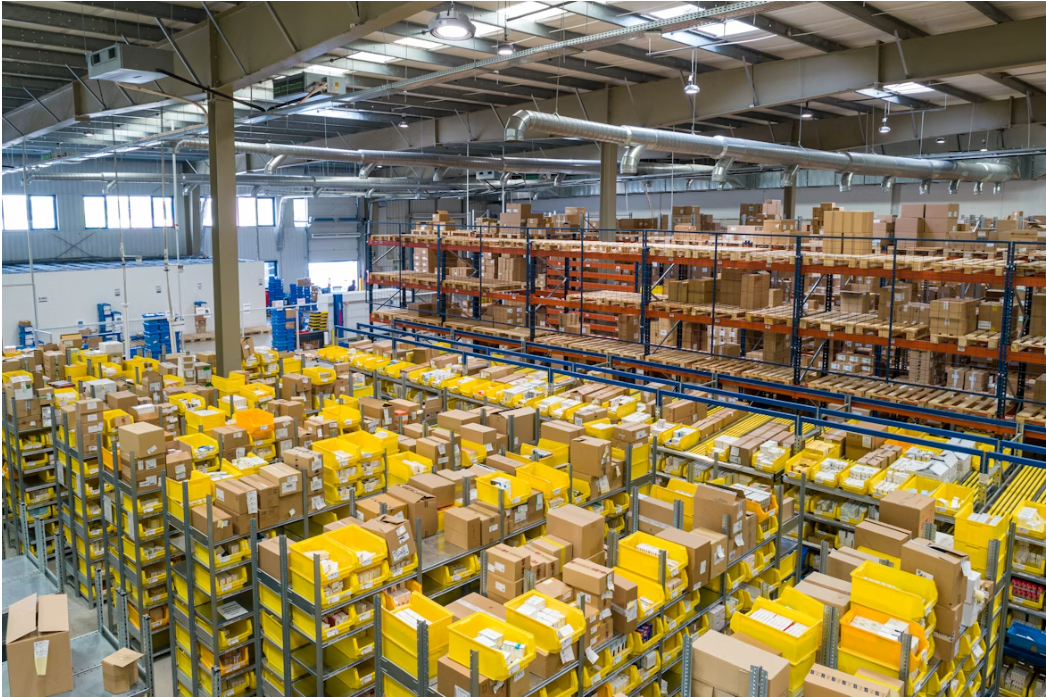 High volume warehouse with organized shelving and packaged inventory. Source: Adrian Sulyok/Unsplash
Learning through simulation
Developing adaptive systems requires a risk-free environment for strategy exploration. Testing in a live facility is impractical due to the potential for physical damage or operational downtime, so development relies on digital replicas. These simulations allow engineers to execute thousands of training scenarios rapidly. By using these virtual environments, a model can refine its decision-making logic through iterative trials without disrupting actual order fulfillment.
The success of the model depends on the interaction between the environment and the autonomous agent. In this context, the agent is the decision-making software that processes data and selects actions based on a mathematical policy. During training, this agent observes the current warehouse state and executes commands, such as navigating to a specific shelf or retrieving inventory. The system then provides feedback based on objective metrics like completion speed and travel efficiency. Over many iterations, the agent optimizes its logic to identify the most productive long-term behaviors.
A central component of this training is the reward function, which encodes the operational priorities of the system. Precise calibration is necessary to ensure balanced performance. For instance, an excessive penalty for travel distance can result in a conservative agent that ignores distant high-priority orders. Conversely, an overemphasis on speed can lead to multiple agents converging on the same aisle, creating bottlenecks. The final efficiency of the system is determined by how well these competing objectives are balanced during the simulation phase.
Performance under variability
Learned policies prove their value when order volume is high and unpredictable. Traditional rules work well under light demand, but they often fail as congestion increases. A reinforcement learning model manages this by treating the warehouse as a fluid system. Instead of following a rigid sequence, the model evaluates how one agent's movement affects others several steps into the future. This foresight allows the system to maintain steady fulfillment rates even when order patterns shift suddenly.
The advantage of this approach lies in its response to dynamic conditions. As more agents and orders enter the floor, the potential for pathing conflicts rises. The model resolves these overlaps by adjusting priorities in real time, preventing the "gridlock" common in static planning. By prioritizing long-term stability over immediate, short-sighted gains, the system remains efficient during peak periods that would typically lead to operational delays.
Integration into existing systems
Reinforcement learning operates as an optimization engine within the existing software stack. It interfaces with the Warehouse Management System (WMS) to receive order data and inventory locations, but it does not replace the WMS as the primary system of record. Instead, it functions at the execution level, taking the static tasks assigned by the WMS and determining the most efficient way to sequence and route them. This allows facilities to adopt adaptive coordination without a full-scale overhaul of their administrative software.
The integration is most impactful when connected to autonomous mobile robots. The reinforcement learning model serves as a high-level fleet coordinator, calculating optimal trajectories based on real-time sensor data from the floor. Rather than following fixed paths, these robots receive dynamic updates from the model to bypass localized congestion or sudden obstacles. This data exchange creates a feedback loop where the software constantly recalibrates hardware movement to maintain high throughput. By managing the low-level logic of pathing and task timing, the model ensures that the physical flexibility of the robots is fully leveraged to meet operational goals.
Constraints and near-term direction
Successful deployment depends on the availability of high-fidelity simulation environments for both training and validation. These models must accurately reflect the physical realities of the warehouse floor to ensure that learned behaviors translate effectively to real-world operations. Safety remains a primary constraint, and most implementations require that safety protocols remain explicit and hard-coded in the control logic. By maintaining these fixed safeguards, engineers ensure that the system cannot override basic collision avoidance or emergency protocols through the learning process.
Computational demands also scale with the size and density of the facility, which often necessitates the use of hybrid architectures. These configurations combine the adaptive nature of learned policies with the reliability of rule-based safeguards to manage system complexity without sacrificing operational stability. As digital twin technology continues to mature, reinforcement learning is expected to move beyond isolated testing and into broader use within high-variability environments like rapid fulfillment centers. Future development will likely focus on reducing the training time required for these models, allowing for faster deployment and easier recalibration as warehouse layouts or order profiles change.
Future outlook
The next stage of development focuses on moving from individual warehouse optimization toward the synchronization of broader supply chain networks. Future implementations will likely emphasize cross-facility coordination, allowing operational logic to adapt based on data shared across multiple nodes in a distribution chain. This shift supports a move toward more autonomous infrastructure where systems can reconfigure parameters to resolve localized bottlenecks with minimal manual intervention. As these adaptive models are integrated into standard industrial software, logistics networks will gain the flexibility required to maintain consistent throughput despite fluctuations in global supply chain stability.
