The digital transformation of warehouse operations is increasingly characterized by hybrid human-automation systems. As global supply chains face labor shortages and increasing accuracy requirements, traditional fixed automation often lacks the flexibility needed for complex manual tasks. Wearable technologies including smart glasses and augmented reality (AR) headsets have emerged as practical tools for supporting human workers during task execution.
These devices provide real-time task guidance directly within the user’s field of view. Instead of relying on paper pick lists or handheld scanners, operators receive visual prompts and confirmations while performing physical actions. This approach reduces interruptions in workflow and allows workers to remain continuously connected to the warehouse management system (WMS) without diverting attention away from the task itself.
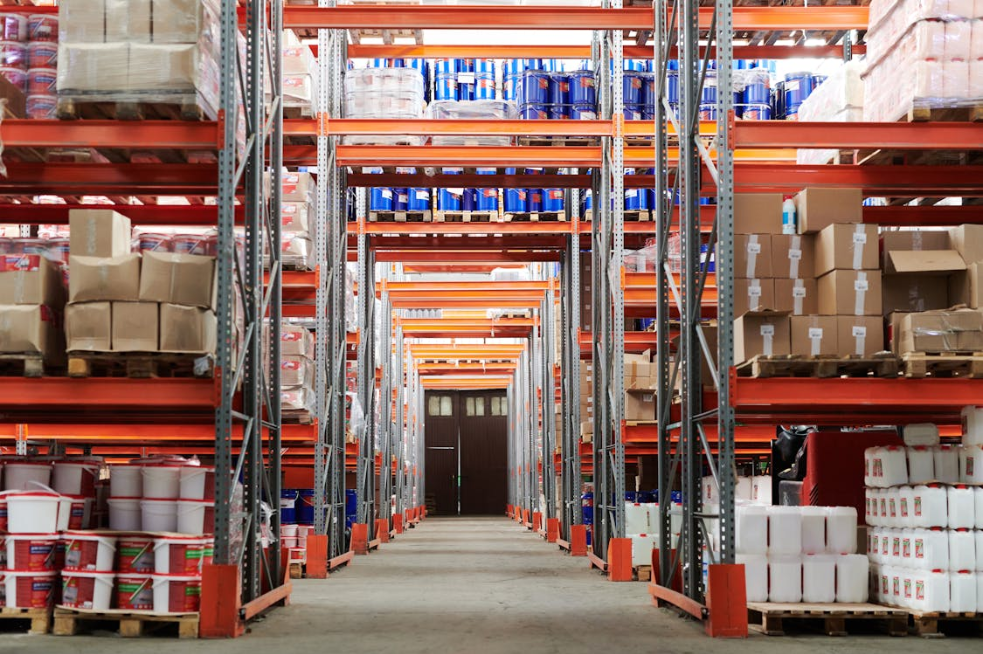 High-density steel racking and shelving units line a central aisle in a storage facility. Source: Tiger Lily/Pexels
Instead of replacing human labor, wearable technologies function as assistive systems that extend the capabilities of the workforce. By embedding digital instructions into the physical workspace, they enable workers to maintain situational awareness while interacting with data in real time.
Wearable technologies and supply chain trends
In logistics environments, wearable technologies refer to body-mounted systems that support hands-free data acquisition and information display. These systems include smart glasses, AR headsets, wearable barcode scanners and haptic feedback devices. Recent hardware architectures combine multiple sensors such as inertial measurement units (IMUs), cameras and proximity sensors. This allows devices to capture detailed information about the worker’s movements and the surrounding environment.
Through sensor fusion, these systems can interpret gestures, body posture and spatial positioning. The resulting data allows the wearable device to present contextual instructions or alerts based on the worker’s current task. For example, when approaching a storage location, the system can display the correct SKU or highlight the target bin within the operator’s field of view.
In high-volume warehouses, a considerable portion of task time is typically spent navigating aisles and verifying storage locations. Wearable interfaces address this inefficiency by providing directional guidance and task instructions directly through a heads-up display. This reduces the need for repeated interactions with handheld devices and minimizes workflow interruptions.
Smart glasses deployment
Within warehouse environments, smart glasses are most commonly used to support order-picking workflows. The devices maintain a continuous connection to the WMS. This connection allows picking instructions to be delivered dynamically as workers move through the facility.
Visual prompts indicate the next storage location, the item to retrieve, and the required quantity. Once the worker confirms the action through a gesture, voice command, or integrated scanner, the system immediately updates the central inventory database. Because instructions remain visible within the worker’s field of view, task transitions occur more smoothly than in traditional scanner-based workflows.
Industrial deployments report measurable improvements in operational performance. Metrics such as lines picked per hour and order accuracy often improve when workers receive direct visual guidance. A key advantage is the reduction of picking errors because the system continuously verifies item selection and storage location during the task.
Successful implementation depends heavily on worker acceptance and ergonomic considerations. Factors such as device weight, battery life and visual comfort influence whether the technology can be used effectively throughout an entire shift. For this reason, organizations typically pair technical deployment with training programs that allow workers to adapt to the new interface gradually.
Sensor fusion and task recognition
Beyond displaying instructions, wearable systems can also monitor task execution using integrated sensors. Motion data from IMUs combined with first-person camera feeds enables the recognition of specific warehouse activities such as reaching for items, scanning labels or placing products into containers. Through machine learning models, these sensor streams can be analyzed to identify patterns and confirm whether a task has been completed correctly. In some implementations, the system can automatically register a completed pick based on recognized hand movements and location data. This reduces the need for manual confirmation.
First-person video feeds also provide contextual information about the surrounding workspace. Image analysis algorithms can detect anomalies such as damaged packaging, misplaced inventory or obstructed storage bins. In this way, wearable devices can function as an additional quality control layer within the warehouse process. From an operational perspective, the collected sensor data offers detailed insights into workflow efficiency. Managers can generate activity maps showing how workers move through the facility. This helps identify congestion points, inefficient routing or repetitive strain risks.
Practical considerations and challenges
Implementing wearable systems requires addressing several technical and operational constraints. Reliable wireless connectivity is essential, as real-time AR overlays and data synchronization depend on low-latency communication with the WMS. Facilities with dense racking and metallic infrastructure often experience signal interference that disrupts consistent network coverage.
Ergonomics strongly influence long-term adoption. Devices must maintain a lightweight, balanced form factor to prevent neck strain and visual fatigue during full shifts. Engineers therefore face trade-offs between processing capability, battery capacity and thermal management. Environmental conditions such as low lighting, mechanical vibration and dust can also degrade sensor accuracy, requiring robust filtering algorithms and regular IMU calibration to maintain spatial tracking reliability.
Vision-based tracking introduces additional data governance challenges. Systems that capture first-person video or skeletal motion data generate detailed performance metrics, requiring secure storage and appropriate anonymization practices. Clear data handling policies and transparent consent frameworks are necessary to address privacy concerns and ensure worker acceptance.
Future directions
Ongoing development in wearable systems is closely linked to advances in artificial intelligence. Emerging platforms aim to move beyond static task instructions toward predictive guidance. In these systems, wearable devices can anticipate a worker’s next task based on historical picking patterns and current warehouse priorities, dynamically adjusting routes or instructions.
Another important development is the integration of wearable interfaces with autonomous mobile robots (AMRs). In these hybrid environments, robots handle transportation tasks while workers focus on item identification and manipulation. Wearable devices function as coordination interfaces, allowing workers and robotic systems to share real-time operational information.
User interface improvements are also expected to play a significant role in future adoption. Voice commands, gesture recognition and adaptive display layouts can reduce training time and make wearable systems more accessible to workers with varying levels of experience.
Implementation outlook
The adoption of wearable technologies represents a strategic shift toward digitally augmented manual labor. By integrating assistive systems rather than pursuing full automation, facilities maintain human flexibility while gaining the precision of data-driven workflows. Success depends on the seamless coordination between hardware, robust wireless infrastructure and the WMS. When these elements align, wearables transform the workforce into a high-visibility, high-accuracy node of the supply chain. As warehouse complexity scales, these systems will serve as the primary link between human intelligence and automated logistics.
