
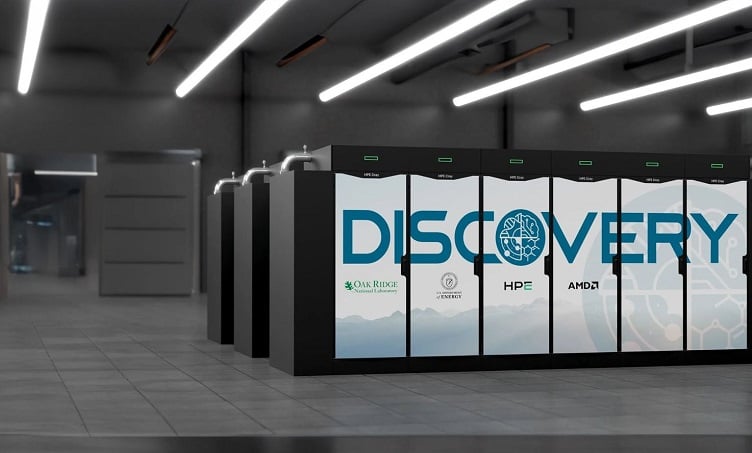
In one of the U.S. government's largest investments in AI-enabled science this year, the Department of Energy (DOE) is teaming up with AMD and Hewlett Packard Enterprise on a $1-billion-plus effort to build two new supercomputers, Lux and Discovery, for national research interests.
Both systems will land at Oak Ridge National Laboratory (ORNL) in Tennessee, already home to several of the world's fastest supercomputers built since the early-2000s. This new generation eyes a different milestone: integrating large AI models directly with the physics-intensive simulations that drive modern research and development.
Lux will arrive first, in early-2026, representing an effort to shorten the usual multi-year hardware development cycle and bring AI-capable systems online faster. Discovery follows in 2028 as ORNL's next major scientific computing platform beyond Frontier, its current exascale system.
What will the new supercomputers do?
Lux and Discovery are engineered for scientific workloads that now pair high-fidelity simulation with large AI models, supporting research in fusion plasma physics, advanced materials screening, protein and pathogen modeling, grid-stability analysis, and classified projects that require AI tools to run alongside tightly coupled simulations.
Many of the DOE’s most urgent research areas are increasingly constrained by the limits of existing compute architectures. First-generation exascale machines excel at large numerical simulations, but they were never built to train or operate the large scientific models that now sit alongside those simulations. Lux and Discovery could redesign the computing stack around that new norm.
Since these models exchange large datasets with physics-based solvers in real time, the AMD accelerators behind both systems — MI355X for Lux and MI430X for Discovery — are built around expanded high-bandwidth memory support, fast interconnect performance and high-precision FP64 compute capable of supporting high-performance computing (HPC) methods as well as AI.
These features are critical for workloads involving high precision and massive datasets. Keeping the machines on-site at DOE labs also reduces the latency and security limits that complicate systems relying entirely on the cloud. Although both supercomputers will be located on-premises, the Lux system will still incorporate a hybrid cloud component via Oracle.
Lux: Next-generation AI supercomputer
Lux will run on HPE's liquid-cooled ProLiant Compute XD685 platform, integrating AMD's Instinct MI355X GPUs, EPYC CPUs and Pensando networking system, with Oracle Cloud Infrastructure supporting development.
AMD's new MI355X accelerators (launched in June 2025) target both generative AI model training and inference workloads, as well as HPC tasks for scientific research. AMD claims MI355X offers roughly twice the AI and HPC performance of competing parts, plus 1.6x larger memory capacity.
 AMD's Instinct MI355X accelerator is built for high-performance computing and AI workloads. Source: AMD
Lux will support research in fusion and fission modeling, materials and quantum science, and grid modernization. It will also anchor the DOE’s broader “AI Factory” strategy to train and refine foundation models within national laboratories. Although other DOE labs are deploying NVIDIA-based systems under the same AI Factory umbrella across the broader federal research ecosystem, Lux is at the center of ORNL's scientific work.
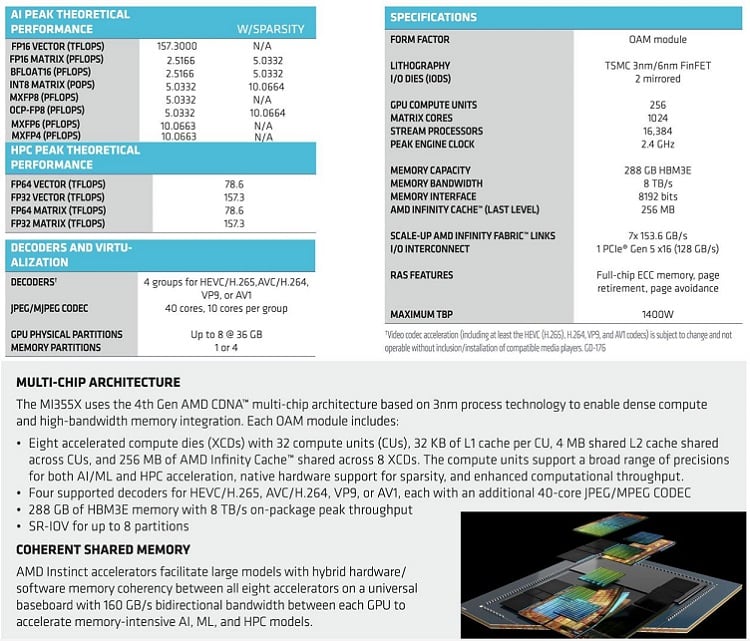 AMD MI355X brochure. Source: AMD
Discovery: Higher bandwidth, performance for AI, research
Discovery is the next major system coming to Oak Ridge, but under the older, more traditional DOE procurement model. Like Lux, Discovery will merge HPC and AI capabilities, allowing ORNL scientists to generate and process massive datasets faster.
Intended as the successor to ORNL's flagship Frontier supercomputer, Discovery could overcome the bandwidth and scalability limits of first-generation exascale systems when it comes online in 2028, speeding up simulation-heavy research across fusion, precision medicine, aerospace and materials science.
Ahead of its 2029 user launch, the Oak Ridge Leadership Computing Facility will select projects for its Center for Accelerated Application Readiness program to tune simulation, data-intensive and machine learning applications for the new system. The lab plans to release a call for participation soon.
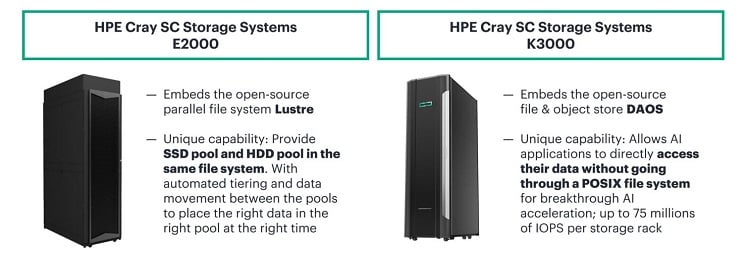 HPE's Cray supercomputing storage portfolio includes E2000 and K3000. Source: HPE
Built on HPE’s new Cray GX5000 architecture, Discovery will use AMD’s upcoming sixth-generation EPYC “Venice” CPUs and Instinct MI430X GPUs, which offer substantially larger HBM4 memory (supporting 432 GB) and memory bandwidth (19.6 terabytes per second) than today’s systems.
For storage, Discovery leverages HPE's all-flash K3000, the first factory-built platform with Distributed Asynchronous Object Storage (DAOS) and integrated open-source software. HPE claims K3000 adds a 300% increase in Discovery's per-rack input/output operations per second, relative to Frontier. K3000 complements Discovery’s existing Lustre-based E2000 storage, giving the system both high-performance object storage and traditional parallel file system capabilities. Both products are manufactured in HPE's supercomputing factories in Wisconsin and the Czech Republic.
Discovery’s “Bandwidth Everywhere” design boosts memory capacity and increases both node-level and global network bandwidth, addressing limitations in earlier exascale setups. The DOE expects its performance will outpace Frontier, the world’s second-largest supercomputer and first machine to break the exaflop barrier when it launched in 2022, becoming the fastest system at that time with over 1 quintillion calculations per second. Discovery preserves the programming environment introduced with Frontier, ensuring a smoother transition for applications built for that system. It also delivers far more output for roughly the same power costs.
Beyond Discovery, HPE is providing systems to other DOE labs as well, including two newly announced NVIDIA-based supercomputers at Los Alamos National Laboratory in New Mexico.
What's next?
Lux and Discovery consolidate much of the DOE’s scientific computing strategy at Oak Ridge, positioning the lab as the primary testbed for AI-based research across energy, materials and national security domains. ORNL has already helped deliver several major flagship supercomputers in two decades, with its last four holding the title of the world’s fastest when they were introduced. These two additions will expand the bandwidth, memory capacity and architectural flexibility needed for ORNL’s most demanding scientific workloads.
