
Four new elements were added to the periodic table. The International Union of Pure and Applied Chemistry (IUPAC) officially approved the names of the new elements, the first of which was discovered a decade ago by Japanese scientists.
As is the tradition, the IUPAC asked the discoverers or synthesizers to name the new elements. Following are the names and symbols of the new elements:

The first element, nihonium (Nh), was named to honor Japan (“Nihon”) by professor Kosuke Morita of the University of Kyushu in Japan. Working at the Japanese research center, Riken, the team led by Morita showed the existence of the element in 2004, 2005 and 2012.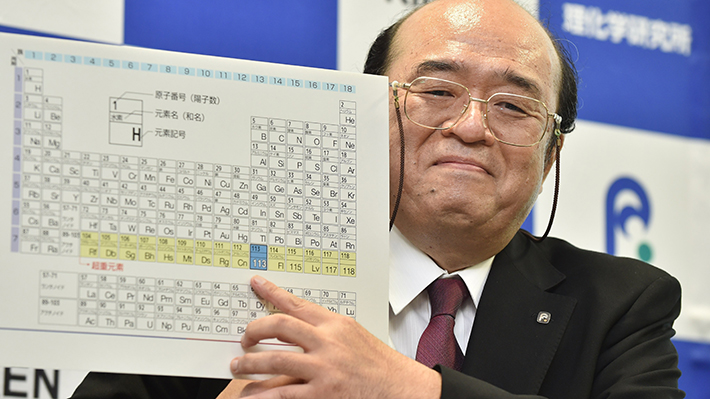 Kosuke Morita celebrates the inclusion of element 113, now known as nihonium. Image credit AFP
The element moscovium (Mc) was synthesized by a joint team of Russian and American researchers. The first synthesis of moscovium was announced in 2003 by the joint team of scientists at the Joint Institute for Nuclear Research (JINR) in Dubna, Russia. The team leader was the Russian scientist Yuri Oganessian and American researchers from Lawrence Livermore National Laboratory. The name of the element was chosen to honor the city of Moscow.
The element tennessine (Ts) was discovered by Yuri Oganessian in Dubna working together with a team of American scientists from the Oak Ridge National Laboratory (ORNL), the University of Tennessee and Vanderbilt University, all located in the state of Tennessee. The new element was named in honor of the state.
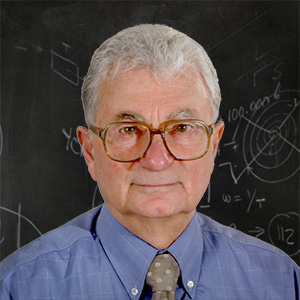 Dr. Yuri Oganessian. Image credit: Texas A&M"The presence of tennessine on the periodic table is an affirmation of our state's standing in the international scientific community, including the facilities ORNL provides to that community as well as the knowledge and expertise of the laboratory's scientists and technicians," ORNL Director Thom Mason said, and Tennessee Governor Bill Haslam added, "The historic discovery of tennessine is emblematic of the contributions Tennessee institutions like Oak Ridge National Laboratory, the University of Tennessee and Vanderbilt University make toward a better world. On behalf of all Tennesseans, we thank this world body for honoring our state this way.”
Finally, the element oganesson (Og) was also discovered by the team at Dubna headed by Professor Oganessian in collaboration with researchers at the Lawrence Livermore National Laboratory. They named the element to honor Professor Yuri Oganessian for his extraordinary ability in scientific research.
Many comments from the general public were received by the leaders of the IUPAC suggesting names for the new elements. However, the suggested names could not be accepted because under the IUPAC guidelines, only the discoverers have the right to name the elements.
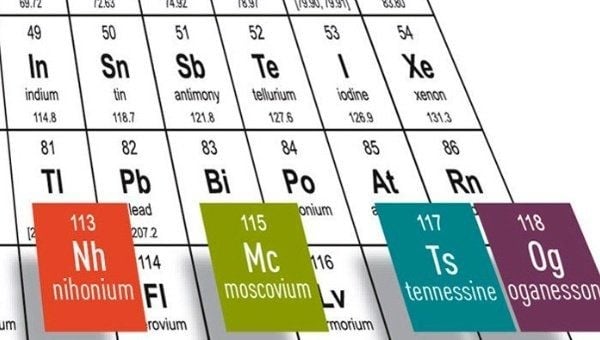 Image credit: IUPAC“Overall, it was a real pleasure to realize that so many people are interested in the naming of the new elements, including high-school students, making essays about possible names and telling how proud they were to have been able to participate in the discussions,” said Professor Jan Reedijk, President of the Inorganic Chemistry Division. He added, “It is a long process from initial discovery to the final naming, and IUPAC is thankful for the cooperation of everyone involved. For now, we can all cherish our periodic table completed down to the seventh row.”
“The names of the new elements reflect the realities of our present time,” said IUPAC President Prof. Natalia Tarasova, “universality of science, honoring places from three continents, where the elements have been discovered—Japan, Russia, the United States—and the pivotal role of human capital in the development of science, honoring an outstanding scientist—Professor Yuri Oganessian.”
