
An autonomous fire suppression system capable of detecting and extinguishing oil fires aboard naval vessels has been developed by a team of researchers at the Korea Institute of Machinery and Materials (KIMM).
Capable of accomplishing this under rough sea conditions, the artificial intelligence (AI)-driven system can verify the authenticity of a fire, activate once a fire is confirmed and direct suppression directly at the source, much like a human firefighter.
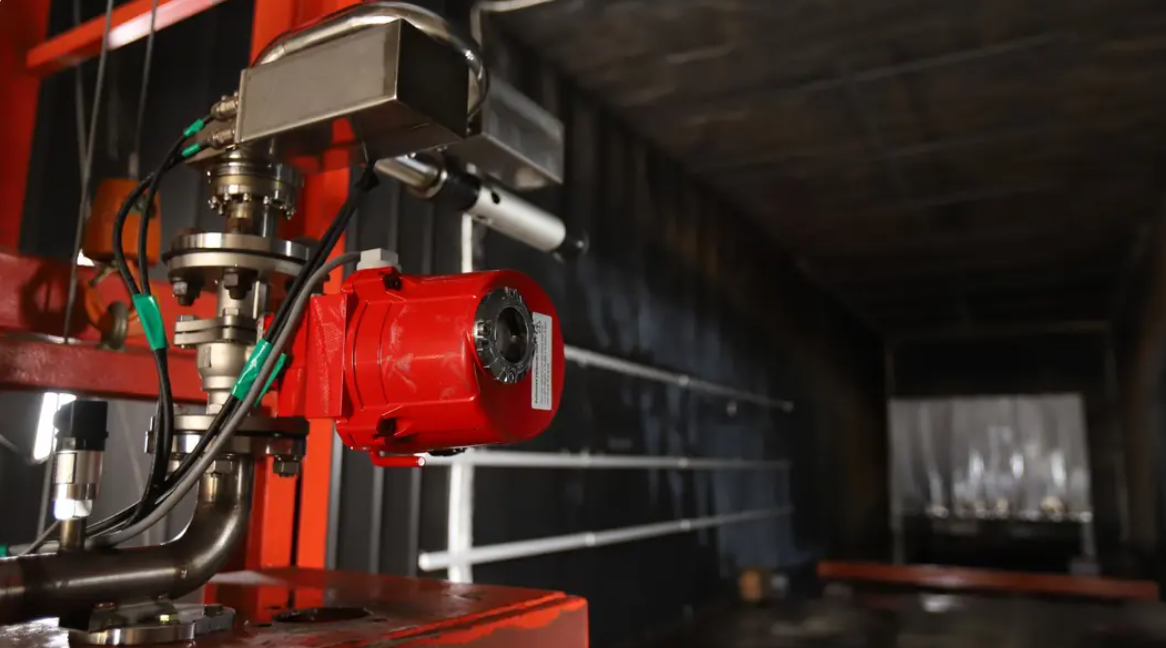 Source: The Korea Institute of Machinery and Materials (KIMM)
The team explained that by using AI-based detection and reinforcement learning, the system adapts to ship movement and sea conditions, thereby ensuring accurate discharge.
The system is comprised of sensors, fire monitors and a control unit featuring AI-based fire verification and location estimation capabilities.
The system has recently completed successful trials aboard a real naval vessel where it targeted fires at their source. During those trials, the system achieved a fire detection accuracy rate of more than 98% and was capable of discharging foam up to 24 meters.
To train the system so that it could accurately identify fires, the researchers recreated various fire and non-fire situations, such as lighters, welding sparks and electric heaters,
The KIMM team also developed a reinforcement learning algorithm that repeatedly adjusts the nozzle’s aiming angle using six degrees of freedom acceleration data to account for wave and hull movement.
“This newly developed initial suppression firefighting system for shipboard oil fires is the world’s first technology to complete step-by-step verification from land-based simulation facilities to actual shipboard environments,” the KIMM team explained. “It can autonomously respond to the most dangerous oil fires on ships in both open and shielded conditions, marking a groundbreaking turning point for crew safety and preserving the ship’s combat effectiveness.”
The researchers suggest that the technology could find applications beyond naval vessels to ammunition depots, military supply warehouses, aircraft hangars and offshore plants.
