
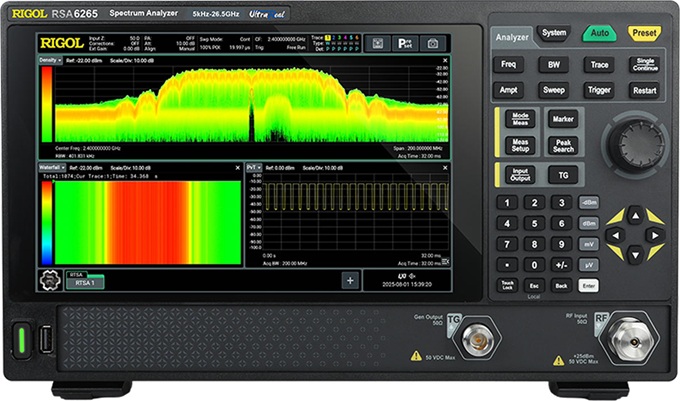
RIGOL Technologies has unveiled the RSA6000 Series Real-Time Spectrum Analyzer, built on the newly upgraded UltraReal platform. This innovative instrument seamlessly integrates high-performance signal capture, multi-dimensional signal analysis and flexible portable deployment, empowering engineers to capture fleeting signals and build their ideal radio frequency (RF) testing workstation.
Performance leap: See clearer, capture faster
The RSA6000 series makes no compromises on RF performance, ensuring engineers can uncover every detail of their signals:
- Up to 200 MHz real-time analysis bandwidth with 100% POI (probability of intercept) as low as 3.83 μs, making transient signals like frequency hopping and pulses fully visible.
- In real-time spectrum analysis (RTSA) mode, scanning speeds up to 4 THz/s enable rapid scanning of ultra-wideband spectra, greatly enhancing efficiency in spectrum monitoring and interference detection.
- Frequency coverage from 5 kHz to 26.5 GHz, supporting diverse testing scenarios from low-frequency communications to microwave radar.
- Exceptional phase noise performance as low as -108 dBc/Hz at 1 GHz, 10 kHz offset, providing a clean benchmark for evaluating critical components like oscillators and phase-locked loops.
- DANL (displayed average noise level) as low as -163 dBm/Hz (typ.), for effortless capture of weak signals.
Analysis leap: Five modes, one versatile instrument
 Source: RIGOL Technologies
The RSA6000 series deeply integrates five core measurement modes, allowing one-click switching to transform into specialized analysis tools, meeting engineers' needs across various testing phases.
|
Experience leap: Flexible deployment, seamless collaborationThe RSA6000 series breaks free from the constraints of traditional benchtop instruments, delivering unprecedented flexibility for engineers.
Versatile powerhouse: Tackling diverse testing challengesWhether in cutting-edge scientific research or demanding industrial applications, this spectrum analyzer delivers comprehensive solutions. In wireless communications and RF testing, it enables deep characterization and validation of components and systems. During electronics R&D and production, it helps engineers pinpoint noise interference sources and ensures fast compliance testing on production lines. For spectrum monitoring tasks, its superior transient signal capture ensures rogue signals have nowhere to hide. In EMI pre-compliance testing, it's an invaluable tool for quickly identifying conducted and radiated issues, speeding up product launches. |
