
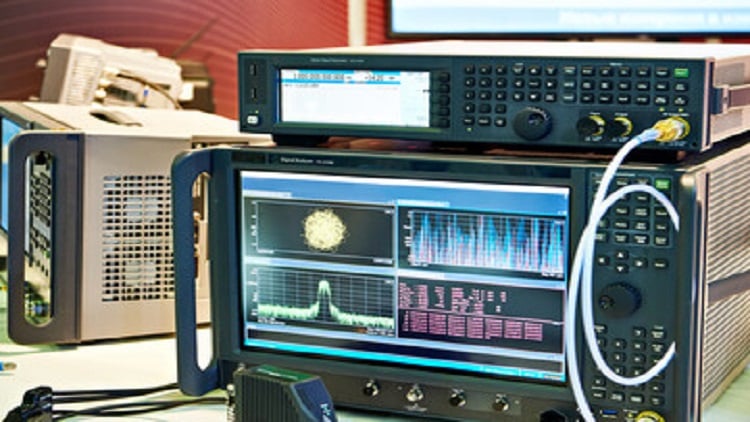
For device simulations, precise models of devices like transistors, inductors and capacitors are required. In order to successfully simulate circuits and resolve difficulties such as power saturation, linearity, harmonics, gain and match, it is necessary to take measurements using a spectrum analyzer and the ultimate broadband vector network analyzer (VNA).
Network analyzers versus spectrum analyzers
The question, "Can a network analyzer be used as a spectrum analyzer?" is an understandable one. When compared to spectrum analyzers, VNAs are very different. How exactly does a network analyzer work? The transmittance and reflection properties of a device under test (DUT) can be measured with the help of a VNA, and the amplitudes of frequencies applied to the VNA's input can be measured with the help of a spectrum analyzer. Is it possible to use a network analyzer to determine impedance? Yes. A spectrum analyzer shows the Fourier transformation of the signals, which shows the different amplitude of each frequency component, instead of the time domain response, as an oscilloscope might.
Dual-purpose analyzers
Fortunately, dual-purpose analyzers that combine spectrum analysis and VNA are available now, which are designed with a mix of hardware integration and software-defined functionalities. Combined VNA and multi-channel spectrum analyzers for characterizing devices with a single connection are available.
Key features:
- Spectrum analysis
- Measures signal power across frequency bands
- Identifies interference, noise, spurious signals
- Used for electromagnetic interference/electromagnetic compatibility (EMI/EMC) testing and radio frequency (RF) signal monitoring
- VNA
- Measures S-parameters (S11, S21) for characterizing components
- Used for impedance matching, filter tuning and antenna testing
- Evaluates transmission/reflection properties of RF networks
Example of measurements for a device under test
Internet of things (IoT) devices operate over various wireless protocols (Wi-Fi, Bluetooth, Zigbee, LoRa, 5G), making RF performance analysis critical. A dual-purpose analyzer (combining spectrum analysis and VNA) helps ensure signal integrity, antenna efficiency and RF compliance in IoT devices. For example, the following parameters can be measured for an IoT device:
|
Test parameter |
Spectrum analysis |
VNA (Vector Network Analysis) |
|
Antenna matching | Not applicable | Measures S11 (reflection loss) |
|
Signal spectrum | Detects RF emissions | Not for spectrum measurements |
|
Modulation analysis | Checks signal modulation quality | Not for modulation |
|
Harmonics and spurious signals | Detects unwanted harmonics | Not used for this |
|
Transmission line loss | Not measured | Evaluates cable/PCB trace loss |
|
Interference testing | Identifies nearby interference | Not used for this |
|
Impedance matching | Not possible | Measures impedance over frequency |
Challenges associated with measurements
Measurement uncertainties can make analysis useless or lead to successful characterization depending on a number of critical characteristics of on-wafer measurements.
A relative measurement is what spectrum analysis is all about. Familiarity with absolute power is useful in certain contexts. Using a power meter, one can set up a power reference point and then take relative readings from there. Consequently, the noise floor and receiver linearity of the spectrum analyzer will determine the accuracy of the measurements. Therefore, relative measurements using a spectrometer during touchdown are usually possible with a reasonable degree of certainty.
Also, VNAs may be power-calibrated at both the source and receiver ends, making them ideal for additional analyses including gain compression, intermodulation, harmonic and noise figure measurements. Their receivers are also quite linear. At mmWave frequencies, where issues with touchdown probe repeatability may arise, the quality and maintenance of the calibration pose a challenge to on-wafer VNA observations. Accurate measurement uncertainties can be achieved using VNA calibration, which identifies and fixes systemic faults. Therefore, the repeatability of the connection (i.e., probe touchdown repeatability), the integrity of the system cables, temperature and other external factors are crucial for maintaining calibration status.
Advantages of dual-purpose analyzers
- Saves money — Instead of buying a separate spectrum analyzer (for checking signal quality) and VNA (for measuring impedance and transmission), you get both in one device. This reduces overall equipment costs.
- Saves space — Since one device performs both functions, it helps keep the lab or workspace less cluttered. This is useful for engineers and researchers with limited bench space.
- Faster testing — Users don’t have to switch between two different instruments when testing wireless signals, antennas or RF circuits. This saves time, especially when debugging RF devices.
- Easier calibration — Instead of calibrating two separate instruments, you only need to calibrate once. This makes measurements more consistent and reliable.
- More uses — A dual-purpose analyzer can test antennas, filters, amplifiers, IoT devices and communication systems. It is useful for industries like telecom, aerospace, automotive, and medical devices.
- Saves time — Engineers can quickly switch between spectrum analysis (to check signal quality) and VNA (to measure impedance and transmission) without reconnecting equipment. This improves workflow efficiency.
- Accurate results — The analyzer provides precise measurements of signal strength, noise, interference, and network parameters (S-parameters). This helps in designing and optimizing RF systems.
- Portable options — Some models are compact and battery-powered, making them ideal for field testing, such as on-site antenna tuning, wireless network troubleshooting and spectrum monitoring.
Conclusion
There are dual-purpose analyzers on the market that integrate hardware and software-defined functions to perform spectrum analysis and VNA simultaneously. Such analyzers may evaluate communication networks, IoT devices, filters, amplifiers and antennas. It finds applications in fields like telecommunications, aerospace, automobiles and healthcare equipment. Reduced clutter in the lab or office is a benefit of having a single item that can do two tasks. This is a great solution for scientists and engineers who are short on workstation space.
