
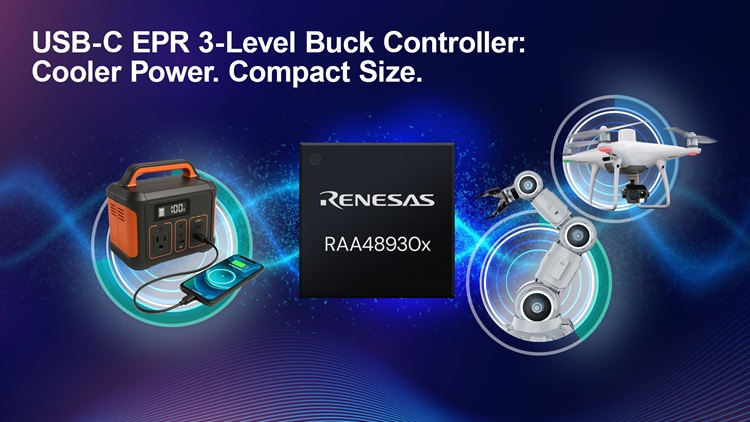
Renesas Electronics Corporation has introduced the RAA489300/RAA489301 high-performance buck controller designed with a three-level buck topology used for battery charging and voltage regulation in USB-C systems such as multiple-port USB-PD chargers, portable power stations, PC docking station, robots, drones and other applications that need a high efficiency DC/DC controller.
The three-level buck converter topology enabled by the new IC delivers exceptional efficiency and significantly reduces the required inductance for regulating the output voltage. Its innovative design minimizes power loss and reduces system size, making it ideal for compact, high-performance applications.
 Source: Renesas Electronics Corporation
The three-level topology consists of two additional switches and a flying capacitor compared to a conventional two-level buck converter. The flying capacitor reduces voltage stress on the switches, allowing designers to use lower voltage FETs with better figures of merit. The result is reduced conduction and switching losses. This topology also enables the use of a smaller inductor with peak-to-peak ripple of only about 25% of that of a two-level converter, enabling reduced inductor core and direct current resistance losses.
The 3-Level DC-DC RAA489300/RAA489301 battery charger and voltage regulator offers superior thermal performance, which reduces cooling requirements and results in cost and space savings. This innovative approach addresses the growing demand for compact and efficient power management systems.
Key features
- Wide range of input and output voltages for use in voltage battery packs and with various PD adapters
- Integrated safety features with built-in protection mechanisms against overcharging, overheating and voltage anomalies
- Scalability for easily adapting to various power levels and application requirements
- Optimized switching architecture divides the voltage across power switches, improving efficiency
- Minimized power consumption, contributing to greener, more sustainable designs
- Lower thermal stress improves system reliability and extends product lifespan
