
A team of computer scientists at the University of Bath in the U.K. suggests that latent robotic devices, such as Roombas for instance, could potentially be reprogrammed to perform tasks around the home beyond their intended functions, thus keeping them physically active while they might otherwise go unused.
Possible functions that such robotic devices might take on, according to the researchers, could potentially include playing with pets, watering plants, carrying groceries from the car to the kitchen, delivering breakfast in bed and closing windows when it rains, among other tasks.
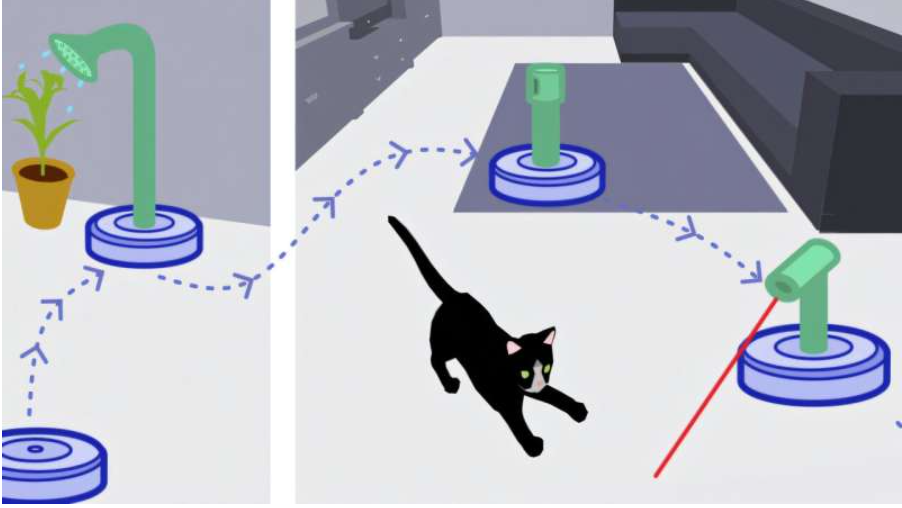 Source: Adwait Sharma and Yoshiaki Shiokawa, University of Bath
As part of the study, the researchers identified 100 functions that domestic cleaning robots might, with some modifications, perform during idle periods. The team demonstrated the practicality of using these idle robots by reprogramming a Roomba to perform the following functions:
- Serving as a mobile wireless charger: The robot, outfitted with a holder, was used to charge a phone and navigate the home to locate the phone user when mobile charging was required.
- Functioning as a workout projector: When outfitted with a projector, the robot displayed workout videos on a wall.
- Operating as a home monitor: The team modified the robot so that it could remotely monitor the home, providing live video and task control.
- Behaving as a work-status signpost: The robot was outfitted with a screen signaling that a "meeting is in progress," to deter disturbances.
"Mobile domestic robots, like robot vacuum cleaners and lawnmowers, are perceived as limited, single-task devices but there is a strong argument that they are under-used for practical tasks. For most of the day, they sit idle. We should be extending their utility beyond their primary tasks by programming them to physically navigate the home to perform a range of additional functions. Just think how much more efficiently households would run if Roombas could be converted into household assistants. Our study proved that after making minimal adjustments, a Roomba can serve multiple roles around the home," the researchers noted. "Idle time presents unique opportunities for value-adding interactions and it aligns with the growing need for adaptable robots and integrated systems that can seamlessly fit into our daily lives. A robot vacuum could, for instance, use its idle time to monitor home security, water the plants or assist an older person to stand from a sitting position. These tasks tap into the robot's advanced sensors, as well as its mobility."
Additional future functions proposed by the study's authors include:
- locating lost items
- changing a channel on TV
- taking photos
- scanning refrigerators and suggesting items that need to be purchased
- entertaining children
- playing games
- interacting with pets
- cleaning cat litter boxes and pet bowls
- detecting unusual sounds and navigating within the home to locate their source
- checking if doors are locked
- cooking alongside humans
- wiping down tables
- clearing and sorting food waste during meal prep
- notifying family members when meals are ready
- organizing items and light cleaning
- moving plants for optimal access to sunlight
- clearing paths of obstructions and alerting users to potential tripping hazards
- receiving and delivering packages
The researchers make their case in the article, “Beyond Vacuuming: How Can We Exploit Domestic Robots' Idle Time?”, which appears in the journal Proceedings of the 2025 CHI Conference on Human Factors in Computing Systems.
For more on the research, watch the accompanying video, which appears courtesy of the University of Bath.
