
A range of electronics from computers and cell phones to data centers and electric vehicles generate heat, which requires removal for optimal operation. An efficient alternative to the common use of metal heat sinks, fans and liquid cooling has been devised to keep these components and systems cool but without consuming extra power or space,
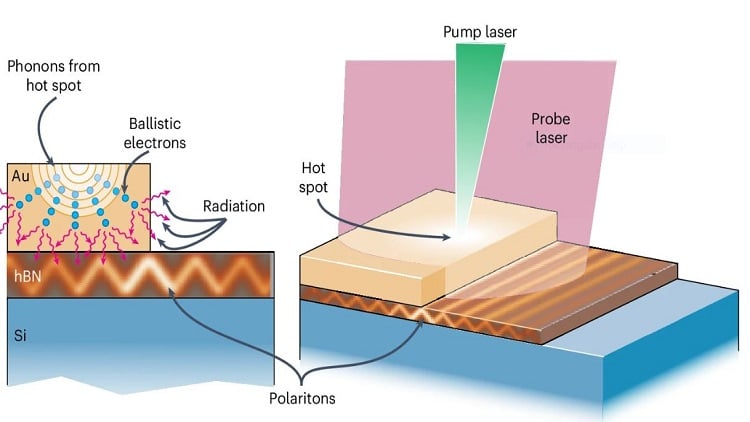
Rather than having the heat slowly dissipate, this new approach transforms it into channeled waves that travel more quickly. Hyperbolic phonon-polaritons (HPhPs) are tasked with this action by means of a special type of vibration within the crystals, coupled with a light-like component in the form of electromagnetic waves. Driven by radiative energy transfer and inherently high propagation speeds, the hexagonal boron nitride (hBN) crystals overcome the limitations posed by conventional phonon heat conduction.
Researchers from Vanderbilt University, Kansas State University, Pennsylvania State University and the University of Virginia demonstrated this cooling concept by heating a tiny gold pad sitting on hBN. This excited the hBN’s HPhP modes, turning the energy into fast-moving polaritonic waves that instantly carried the heat away across and away from the interface between the gold and hBN. The heat transfer was observed to be 10 to 100 times more efficient at the interface when HPhPs were involved.
“This method is incredibly fast,” reported the researchers. “We’re seeing heat move in ways that weren’t thought possible in solid materials. It’s a completely new way to control temperature at the nanoscale.”
The technology described in Nature Materials could greatly improve cooling in high-performance electronics, allowing for faster, more powerful devices that don’t overheat.
