
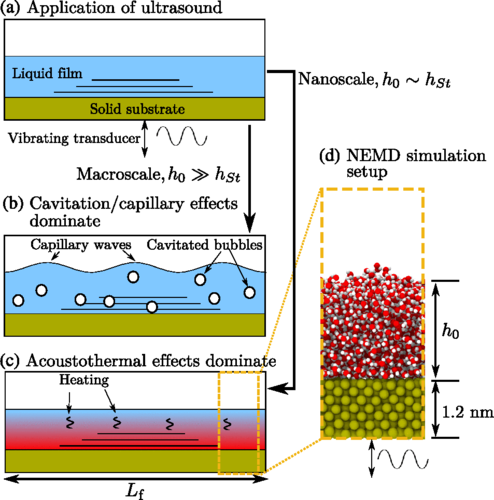
 Schematics of typical ultrasonic atomizer setup, macroscale conjunction theory of atomization, nanoscale acoustothermal heating and atomization, and the NEMD problem setup for the simulations. Source: University of EdinburghA team from the University of Edinburgh has used computer simulations to find that ultra-fast vibrations could be used to heat tiny amounts of liquid.
This theory could be used in a range of engineering applications, such as preventing ice build up on plane and wind turbines, enhancing cooling systems in smartphones and laptops and improving drying time on dryers while also consuming less energy.
The computer simulated very thin layers of liquid, thinner than a human hair, that can be boiled just by vibrating the layers at extremely fast rates. The fast vibrations convert the fluid into heat as the liquid molecules collide. These tiny vibrations could be used to boil small quantities of liquid and the energy produced by the liquid could be applied to larger volumes of liquid, therefore producing waves and bubbles that help with heating and cooling processes in electronics and more.
The team used the Archer U.K. National Supercomputing Service computer to run the vibration simulations.
Dr. Rohit Pillai, of the University of Edinburgh's School of Engineering, said, "Exploiting this new science of vibrations at the smallest scales could literally shake things up in our everyday lives. The advent of nanotechnology means that this discovery can underpin novel engineering devices of the future."
The paper was published in Physical Review Letters.
