
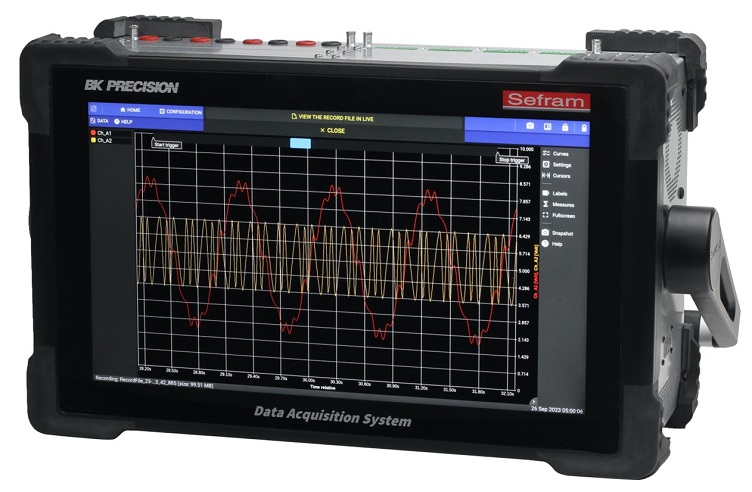
If your business is in the market for a new data acquisition recorder, there’s more than one reason to consider the newest addition to the B&K Precision line. The DAS1800 offers an extensive set of features that raises the bar for performance and configurability.
Data acquisition recorders can be thought of as the slow-moving cousin to digital storage oscilloscopes — to make an analogy to Aesop’s fables, one might say they’re the tortoise to the hare. And we all know that it’s a mistake to underestimate the tortoise. As B&K Precision explains in its write-up on choosing a data acquisition system, both are versatile instruments that capture and display time-varying signals; both also include signal analysis tools and data logging capabilities.
Yet while the fast-sampling rates of a DSO makes it well-suited for analyzing high-speed or transient signals, a DAS leverages deeper memory and slower sample rates to look at data over longer periods of time. Data acquisition systems also provide higher channel counts and multiple input types: Whereas a typical DSO has two or four inputs, a DAS can scale to hundreds of channels that can each be configured for specific types of sensors.
(Learn more about data acquisition equipment with Globalspec’s specification guide)
The B&K Precision line starts with the DAS200 series of small and portable units with 32 GB of memory, 10 to 200 channels and a maximum sample rate of 1,000 samples per second. Models in this series use multiplexed sampling — the instruments acquire single data points from enabled input channels, each of which share a common analog-to-digital converter (ADC). Since sampling rates are limited by the number of channels, the multiplexed sampling scheme is best suited for collecting static measurements across many channels for extended periods of time. Example applications include temperature logging and process monitoring.
Moving up to the multifunction DAS30/50/60 series brings simultaneous sampling — samples are acquired simultaneously at user-defined rates. Each channel has its own ADC, synchronized to a common time base to allow time stamping. Models in this series offer fewer channels (two to six) but higher sampling rates (up to 1 million samples per second, or 1 MSa/s), making them a fit for applications such as maintenance and failure analysis, electrical power analysis and motor testing.
The top-of-the-line models are high-speed systems with fast (1 MSa/s) sample rates, high channel counts (up to 72) and ample storage space (up to 200 TB) for recording data over long periods. These models, which include the DAS1700 and the new DAS1800, are also configurable to allow for upgrades as testing needs change. Compared to the older model, the DAS1800 increases the number of measurement module slots and channels for simultaneous sampling while also boosting life on the optional internal battery from 2 to 3.5 hours. The battery-configured model also weighs just 15 lbs (6.8 kg), making it what B&K Precision calls the lightest all-in-one system in its class and an ideal solution for field testing. For complete specs on the DAS1800, click here.
