
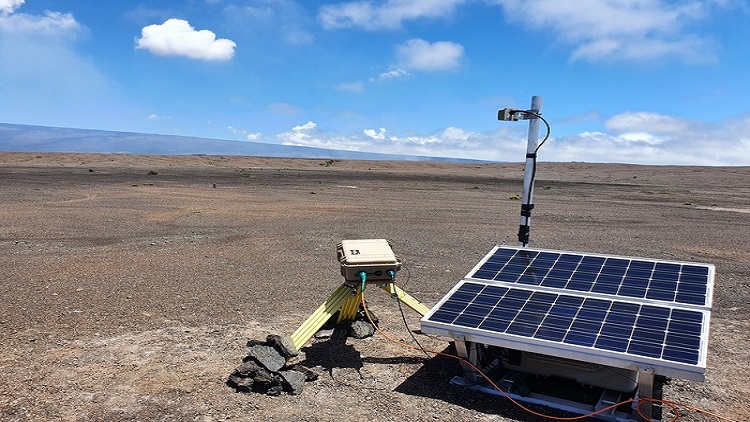
A new low-cost ultraviolet (UV) camera capable of monitoring volcanic emissions of sulfur dioxide (SO2) gas continuously enhances prospects for improving the reliability of impending eruption forecasts.
The system engineered by an international research team incorporates sensors from Raspberry Pi cameras modified to strengthen UV sensitivity by removal of their Bayer filter. A UV-transmissive optical system for a triplet lens setup was also designed using Zemax ray tracing software, reducing the degree of spherical aberrations at the edges of images seen in previous efforts.
Data acquisition is controlled by software written in Python 3, and data processing can also be performed using the freely available PyCam software. Use of compact differential optical absorption spectrometers that do not require thermoelectric cooling reduces instrument cost and complexity, and restricts power consumption to less than 4 W.
The solar- and battery-powered camera has been field tested to generated initial data sets for a volcano in Chile and a site in Hawaii. Results reported in Frontiers in Earth Science indicate good agreement with earlier measurements on SO2 plumes,
The instrument developed by researchers from the University of Sheffield, Sheffield (U.K.), Millennium Institute on Volcanic Risk Research (Chile), Universidad Católica del Norte (Chile), U.S. Geological Survey (Hawaii), U.S. Geological Survey (Washington), University of Sydney (Australia) and University of Cambridge (U.K.) can provide higher time- and spatial-resolution data and facilitate new volcanological research when installed permanently, all while reducing equipment cost from thousands to hundreds of dollars.
