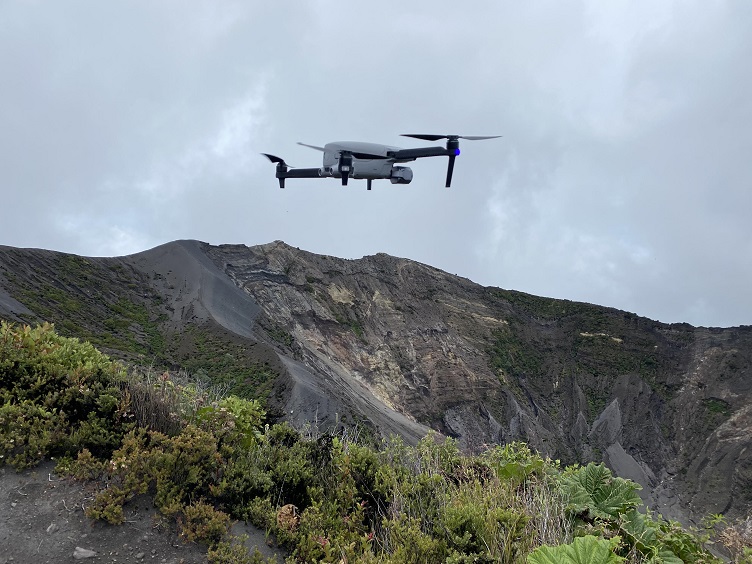
Autel Robotics’ drones are being used by a scientific team of international academics to document activities on Irazú Volcano in Costa Rica.
Autel’s EVO Lite+ drone was selected due to its sensor suite and durability. The drone was particularly chosen due to being able to fly safely through 17 knot winds. The drones can fly up to 37 knots, enabling it to be fit for a high-altitude project.
The drone was piloted by Ian Godfrey, a certified FAA Part 107 Remote Pilot, who is SINAC Certified for unmanned aircraft system (UAS) operations in National Parks. The drone performed well despite the high-altitude volcanic environment at 3,432 meters above sea level in windy conditions.
The team gathered data on several aspects of the main crater of the Irazú Volcano including:
- Lake water levels
- Areas of mineralization or crystallization
- Potential vents degassing volcanic emissions
- Future rock falls and increased risk of erosion or cracking
The EVO Lite+ camera drone stays in the air for 40 minutes and features cinematic flight modes, professional grade camera, ultra-wide angle obstacle avoidance such as trees and rocky outcrops and a transmission range of 7.4 miles. Additionally, the UAS is capable of creating 2D maps and 3D models of volcanic features.