
With more sensors, actuators and wireless control features being added into the smart home ecosystem, it’s increasingly hard for designers to meet product standby power requirements using discrete buck converters, which are inefficient in standby and require additional circuits for detecting AC line zero-crossing.
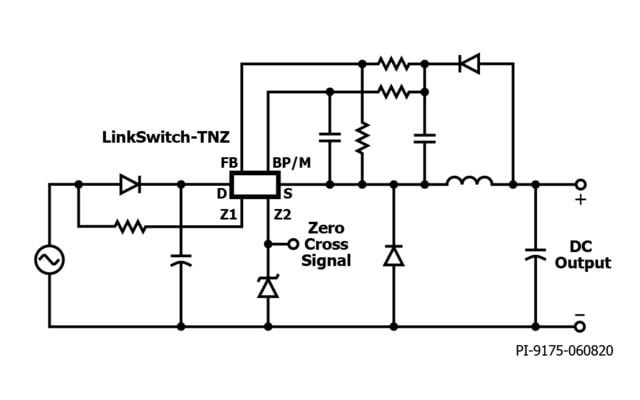
The LinkSwitch-TNZ family of integrated circuits (ICs) from Power Integrations offers a highly integrated alternative by combining offline power conversion with lossless zero-cross detection. This enables best-in-class light-load efficiencies and allows more system features to be powered while still meeting stringent standby regulations.
 Source: Power Integrations
A new design example report describes a two-wire Bluetooth Low-Energy (BLE) wall switch for smart lighting or motorized shading using LinkSwitch-TNZ. It minimizes leakage current and does not require a neutral wire. The design supports smartphone app control and draws lower than 150 µA input current in standby at 230 V AC.
LinkSwitch-TNZ ICs provide an accurate signal indicating that the sinusoidal AC line is at zero volts. This signal is used by smart home products to control the switching of relays, insulated-gate bipolar transistors and triodes for AC to minimize switching stress and system in-rush current. The DER-867 two-wire BLE wall switch utilizes this unique feature for automatic set/reset time calibration, allowing the relay to be switched at zero crossing even if the user requests for an asynchronous turn-on via the app or physical switch. Alternate relays with varying set and reset times can be used interchangeably and still switch at zero-crossing.
