
Reports on testing from the electric vehicle (EV) segment continue to hit the Electronics360 news desk, with recent developments in EV battery validation, fast-charging applications and vehicle systems design. Here are a few highlights.
First, NI announced its highest voltage battery cycler, the 150 kW High Power System-17000 (HPS-17000), which it says was developed to modernize battery validation labs. Designed to support existing EV architectures while also leaving room for future higher-voltage variants, the modular design of the HPS-17000 is built for scalability, increased layout flexibility and lower cost of maintenance.
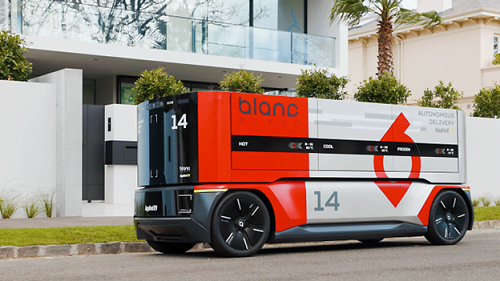 Australian company Applied EV is using the Siemens Xcelerator portfolio of software and services to support the design, quality assurance and build of its next-generation autonomous vehicles, like its Blanc Robot above. Source: SiemensNI’s time-sensitive networking technology allows multiple devices to be synchronized for parallel operations, allowing easier reconfiguration of test systems; cycler actions can also be correlated with external measurements, at microsecond-level resolution, via synchronization with current and voltage sensor units. The new system also goes beyond battery cycling, with standardized power- and application-specific breakout sections that can be employed in contexts such as inverter testing and dynamometer applications.
Small footprint
Keysight Technologies announced an enhanced Scienlab Regenerative DC Emulator (SL18000A Series) for EV fast-charging applications, which can achieve DC charging tests up to 270 kW in a small footprint; it can also be paralleled to achieve realistic EV battery emulation up to 1.5 MW.
In addition, the system’s regenerative design allows absorbed power to be delivered back to the grid, saving on energy and cooling costs. The series is fully integrated into other charging discovery system and software components from Keysight.
PLM focus
Siemen Digital Industries Software announced that Applied EV, an Australian specialist in autonomous-ready digital control systems and modular vehicle platforms for commercial applications, is using Siemens cloud-native Teamcenter X software to support the design, quality assurance and build of its autonomous vehicles.
The software, which is part of the Siemens Xcelerator portfolio, is focused on product lifecycle management (PLM). Applied EV’s core product is its Digital Backbone (DBB), a purpose-built software control system for electric and autonomous applications designed to reduce hardware complexity and support the next generation of vehicle architectures to be completely software defined.
Additionally, automotive radar manufacturer Cubtek is leveraging Rohde & Schwarz products to develop 4D imaging radar, something it says will be indispensable to future self-driving vehicles.
