
Sponsored Content
Business Process Solutions
PLM and the future of smart manufacturing
04 November 2019
Sponsored content
Rise of the digital twin
A digital twin may sound like something from a sci-fi film, but it is a lot closer to reality — and it is a key concept in modern product lifecycle management (PLM). Digital twins are essentially simulation models that mirror the status of physical counterparts, updating themselves in near real-time. The physical counterparts upon which the twin is based include both products and the manufacturing processes used to produce them.
It is perhaps no coincidence that the concept was given such a human-sounding name. In fact, it is sometimes referred to as a “living” simulation: By employing machine learning and software analytics on multiple streams of data, digital twins are able to learn from other machines and systems, from human engineers and from themselves. Most significantly, digital twins are not limited to analyzing the past. They can use historical data to draw conclusions; they can essentially ask “What if?” and forecast into the future.
The digital twin is seen as a disruptive technology for PLM, able to cut through inefficient processes throughout all aspects of a product lifecycle. This goes beyond improvements to the speed of design, production and delivery; opportunities exist to drive manufacturing in new directions that would have been previously unimaginable.
An example is the prospect of mass customization — a possibility that significantly opens up when each physical product has a live digital representation that can be designed and produced to meet individual needs. Another example is continuous optimization of products through a closed-loop lifecycle: Development need not end at the point where the product is handed over to the customer. The digital twin can be used as a sandbox for new idea testing that can inform its physical counterpart, and vice versa. It can also launch remote maintenance services as needed, essentially allowing a product to self-heal.
It is possible that digital twins linked together by different companies across a business ecosystem could establish virtual supply chain networks. These would offer more choices to participants; provide the tools for better decision-making; and perform preemptive corrective actions that would minimize, or even eliminate, unplanned shutdowns.
Feeding more data to a digital twin enables it to play increasingly complex roles within a system — given the sufficient computing power, of course. This explains why larger enterprises have been early adopters of digital twin technology, the prevalence of which is still in the early stages. But greater access to computing power is also a key aspect of the growth of cloud computing; the cloud is poised to be a path for small- to medium-sized businesses to reap the benefits that digital twin technology has to offer. Numerous financial forecasts have identified cloud PLM as a major growth area over the next five years.
Potential use cases for digital twin technology are many, extending beyond PLM and reaching into numerous industries. Businesses and ecosystems will continue to follow individual development paths, just as they always have, but with the rise of the digital twin, they may no longer be making the journey alone.
 Figure 1: Digital twins are essentially simulation models designed to mirror the status of physical counterparts, updating themselves in near real-time.
PLM as a key driver of Industry 4.0
Industry 4.0 is something of a buzzword, which describes the trend toward smart factories driven by technological advances in areas such as automation and data exchange. While aspects such as robotics and artificial intelligence tend to command more attention from the press, product lifecycle management (PLM) is no less important as an Industry 4.0 driver. Its importance is paramount, and the explanation is simple: PLM is a large reason that digital factory transformation is happening in the first place.
New technologies are only as useful as their applications. In manufacturing, this translates to things like increasing factory efficiency, streamlining the supply chain, speeding new product development and providing superior product service — in other words, the very things that PLM seeks to address. Enterprises are adopting elements of Industry 4.0 to better manage the lifecycle of the products they make.
Take a basic internet of things (IoT) application as an example. Sensors can be fitted into a company asset such as a piece of manufacturing equipment; machine learning can then interpret the data collected by those sensors and provide new insights for predictive maintenance, which can have a positive impact on factory efficiency.
 Figure 2: PLM is an important Industry 4.0 driver.This is just the tip of the iceberg. By networking multiple pieces of equipment together, a feedback loop is created. This allows operators to control machines not as individual units but as a cohesive system that stretches from the factory floor into the supply chain. Manufacturers are now applying similar IoT technologies to products themselves, imparting upon them a native intelligence that provides much deeper insights. Actual data on product performance, for instance, can guide improvements to product design and shorten the time needed for product design cycles.
There is also an evolving business model toward selling products “as-a-service,” which is an ideal use case for the type of agility that IoT technologies can provide. Office printer deployment offer an example: the equipment is typically leased rather than owned, and customers pay for a service contract. More recently, some of the larger printer manufacturers have built sensors into their printers that identifies when ink cartridges are low and automatically order replacements.
This might sound like pie-in-the-sky for small- to medium-sized businesses, given the expected costs of Industry 4.0 integration. Yet, the as-a-service model extends into the more challenging aspects of smart factory establishment as well. Sensor data itself, which is easy to collect but difficult to interpret, can be analyzed as a service. With the right mechanisms in place, this has the potential for a profound and positive impact on PLM for all sizes of enterprise — along with the digital transformation that follows naturally in its wake.
Cloud technologies bring PLM to all
Product life management (PLM) in the cloud, while still in its nascent stage, is changing the way many companies do business.
PLM software has typically been used by large enterprises to organize product data, enabling teams to collaborate through all of a product’s stages. However, the need to collaborate is ubiquitous across the value chain; that’s where cloud-based PLM is growing in importance.
PLM in the cloud is an internet-based system for managing a product and its associated information from the design stage all the way through to the end of that product’s life. The technology is used by numerous vertical markets in order to collaborate, track and regulate changes to the product. Similar to on-premise PLM, cloud PLM allows manufacturers to consolidate information about product development, streamline change orders and requests, and improve communication with suppliers. Because cloud PLM is available to anyone with an internet connection, it is an easier way to manage the complexities of product data, especially for companies with geographically dispersed organizations.
The main advantages of cloud-based PLM include:
- Easy implementation
- Facilitates innovation
- Better collaboration
- Low cost of ownership
- No hardware purchases
- Secure access anytime, anywhere
- No upgrade deployment delays
- Unlimited storage
“PLM is changing really quickly,” said John Laslavic, founder and CEO of Upchain, a PLM developer. “Cloud technology, among other factors like software-as-a-service models, has let companies like Upchain bring the benefits of PLM to businesses beyond enterprise organizations who can afford multi-million dollar software solutions by cutting the cost of PLM by upwards of 90 percent.”
This means that medium-sized companies and startups can now take advantage of the technology in the context of the internet of things (IoT) and Industry 4.0, which is a great first step, Laslavic said.
Garth Coleman, ENOVIA vice president of marketing at PLM vendor Dassault Systèmes, agreed that cloud PLM gives customers of all sizes access to digital transformation technology without the need for expensive hardware and complicated deployment roadmaps. Cloud PLM ensures that companies are using compatible software and prepares them to support future trends and capabilities, from wearable technology to next-generation CAD to anything else. The technology also allows smaller firms to compete with larger enterprises without huge investments in IT infrastructure, software or staff. Cloud PLM offers quick deployment and low upfront costs, Coleman said.
“There are also exclusive capabilities thanks to the cloud — continuous updates that are done by Dassault Systèmes, versus highly-customized on-premises deployments that are often several releases behind and are time-consuming and complex to upgrade,” Coleman said. “This allows the cloud customers to always benefit from the latest-and-greatest enhancements, and to ‘grow as they go.’”
Technavio forecasts the global market for cloud-based PLM will post a compound annual growth rate (CAGR) of more than 12% during the years 2018 through 2022. The market research firm said that in the Americas, cloud-based PLM could account for a market share of more than 63% by 2020. Much of that region’s growth will be attributed to the automotive sector’s increasing demand for cloud PLM, specifically through domestic manufacturing replacing outsourced parts.
Who uses cloud PLM?
Cloud-based PLM is emerging in a number of industries across the global value chain. Early adoption has been in the aerospace and transportation, sectors with many startups focusing on unmanned aerial vehicles (UAVs) and self-driving cars. The technology allows manufacturers to collaborate through the entire product development process on a single platform without information delays or discrepancies.
In the industrial market, products need to be precise, reliable and innovative to meet the needs of Industry 4.0 and the IoT. From initial design to mass production, cloud PLM is used to ensure streamlined development of high-quality of products that are delivered on time.
In the consumer electronics market, with an extensive network of global suppliers, constant product iterations are the norm and are necessary to keep up with the competitive landscape. Cloud PLM is a fit here because of the collaborative nature of the software, allowing people to access product data from anywhere.
The future of cloud PLM
What’s next for cloud PLM? The expanded use of the IoT will bring more capabilities to numerous markets that will be enhanced by PLM technology. Also, the rise of Digital Twin technology — a real-time digital replica of a physical device — will be expanded further, using cloud-based PLM.
“[Digital Twin technology] enables a complete virtual model of the real world, that can be simulated, tested, and optimized to not only improve the real delivery of the real object, but to help predict future outcomes based on real performance data and implement solutions well before failures occur,” Coleman said.
PLM isn’t like other software.
Return on investment (ROI) can’t be calculated from a single number.
Product lifecycle management software slips and slides into the crevices of your business.
It wraps itself around your organization and delivers:
- Time savings
- Cost savings
- Reduced opportunity cost
- Better risk management
Each of which contributes to the ROI of PLM.
And yet, the ROI of PLM is so often held to a single metric: time to market.
But we’ve had enough.
Today, we’re taking a look at a better way to measure the ROI of PLM, so you can get to the bottom of what it’s worth to your organization.
The problem with how PLM ROI is normally done
The normal way of calculating the ROI of PLM is that it’s incomplete.
Normally, PLM ROI is calculated on time to market.
If you get to market, say two months faster, then you have two months of additional revenue.
And this is a great start.
But it’s not the whole story (we’ll come back to time to market later).
As one Forrester report noted:
When seeking to improve a company’s product development effectiveness, executives commonly consider strategic measures such as time to-market.. However, all too often, measurable impact proves elusive to managers seeking to drive more-pragmatic improvements such as speeding change-order cycle times, reusing a larger percentage of designs, and reducing product defects and rework.
First, PLM touches every aspect of product development. It helps:
- Engineers and designers work faster and focus on high-value tasks
- Procurement buy better parts
- Suppliers work and iterate more efficiently.
Efficiencies in each of these areas helps fuel getting products to market, for less and thus contribute to the ROI of PLM.
Efficiencies in each of these areas helps fuel getting products to market, for less and thus contribute to the ROI of PLM.
Second, PLM also supports a “fail fast” approach to manufacturing.
Mistakes can happen early when they’re cheap rather than later when they’re expensive.
There’s value there in opportunity cost that’s difficult to quantify.
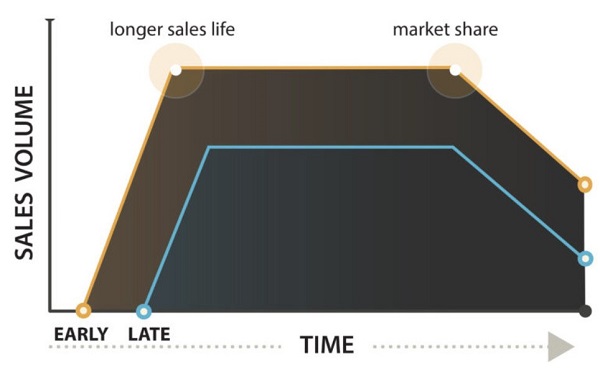
Third, calculating the value of getting to market early isn’t a straightforward calculation.
The value of getting to market early plays out over the lifespan of the product, where an early advantage leads to significantly better market share and thus returns.
The true cost of PLM
So that’s the first problem with the ROI of PLM: it’s really difficult to calculate total benefits of PLM.
The flipside is that understanding the true cost of PLM is equally difficult.
Not only do you have the sticker price, but you also have implementation, consultation, customization, and training fees for a project that might unroll over years.
Just understanding the total cost of ownership (TCO) of traditional PLM is brain-wrinklingly complicated.
Fortunately, there’s a better way to calculate and measure the ROI of PLM.
A better way to measure the ROI of PLM
There’s no single answer to the ROI for PLM question.
It’s different for every organization.
And often, the true value only emerges completely after several production cycles.
Which isn’t a lot of use for forecasting and justifying a PLM purchase.
So here are the three factors we think that organizations should look at to get a more complete picture of PLM ROI.
(We’ve adapted this from an old Forrester report, which looks at the ROI of traditional PLM. It’ worth a look if you want more of a deep dive.)
- Operational efficiency
- Cost reduction from efficient part use
- Improved time to market
Let’s dig into these.
Operational efficiency
PLM doesn’t get the credit it deserves when it comes to making teams more efficient.
PLM makes engineering work more efficiently by cutting out grunt work and freeing up staff to focus on high-value tasks.
To see this in action:
- Take the total number of engineering hours you booked last year (this is usually just the number of engineers x 40 hours x 52 weeks)
- Minus your projected PLM time savings (our clients see about a 20% improvement in project completion times, so say 20%)
- Multiply the hours saved by your average engineering hourly wage (say, $125 per/hour).
That gives you a dollar figure for engineering efficiency.
For instance, say you have 10 engineers. That means you booked 20,800 engineering hours last year. At $125 per hour, that’s $2,600,000.
If you save 20% of that after a PLM deployment, that’s an annual saving of $520,000.
Cost reductions from efficient part use
Part reuse and SKU reduction are a bit like operational efficiency.
It’s not a core objective of PLM (usually).
Usually, it’s an auxiliary benefit.
But it’s one that can be extremely valuable to a business.
For instance, the Department of Defense found that every new SKU (e.g. part) introduced in their system cost them $27,500 on average.
The Department of Defense found that every new part introduced in their system cost them $27,500 on average.
Now we have no allusions.
Not everyone is the DoD.
But if every part even costs you even 1% of that startlingly large figure, you’re still looking at $275 bucks per part.
Now consider another statistic:
Designers spend 80% of their time designing or finding parts that already exist — parts that could easily be compiled from existing stock.
What this means is that most organizations can potentially save enormous pots of money just by managing their parts, inventory, design work and ECRs better.
Of course, calculating this ahead of time is incredibly difficult.
That’s part of the reason we run so many pilot projects — trying out PLM is usually enough to get an idea of what sort of decrease in rework/ECRs/design costs you can expect with a larger rollout.
It’s also not just abstract:
- One company reported an 80% reduction in development costs following a PLM implementation
- Another company reportedly saved $250 million from efficient part use alone
To see this in action:
- Calculate how many of parts you’re using that are designed from scratch
- Calculate your average per part cost, including design time
- Multiply them together
For example, say our project has 300 parts, and assume that 80% were designed or redesigned from scratch.
That’s 240 parts.
Assume that each part costs $4,500 to design and machine, that would be a cost savings of $1,080,000.
This isn’t perfect, but it’s a good way to think about the ROI of PLM beyond the obvious functions of organizing product data.
The ROI of getting to market faster
Yes, we know we disparaged this earlier as a high-level metric with little (if any) meaningful value.
But we’re going to look at it anyway.
Just from a slightly different angle.
We’re going to look at it as a risk to be mitigated by PLM.
That is, what does a missed deadline cost you? What are the consequences of that, and how much would you pay to avoid those missed deadlines, given the broader benefit of getting to market quickly (remember the graph above)?
Because missed deadlines are expensive. They can cost a 12% drop in share price on average.
Missed deadlines can cause a 12% drop in share price.
So by speeding time to market by, say, 10%, you might miss 5 fewer deadlines every year.
That’s some serious risk mitigation right there.
Powered by CR4, the Engineering Community
Discussion – 1 comment
By posting a comment you confirm that you have read and accept our Posting Rules and Terms of Use.
Advertisement
Advertisement
Popular News
Find Free Electronics Datasheets

Advertisement