
Companies have been feeling the pressure to incorporate more automation into their testing strategies, according to a recent global study conducted by Forrester and commissioned by Keysight Technologies. Yet it remains a significant challenge: Despite 84% stating that most testing involves complex systems, few employ automated testing or use artificial intelligence.
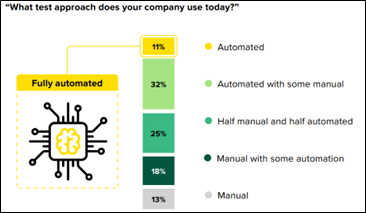 Results of a recent study revealed that few companies take a fully automated approach to testing. Source: Keysight TechnologiesThe research report, titled “Conquer Testing Complexities with Automation and Artificial Intelligence (AI),” surveyed test operations decision-makers to understand the state of test strategies and technologies. It identified that automation is indeed gaining inroads among organizations: 75% use some combination of automated and manual testing. However, only 11% have a fully automated strategy. With growing complexity, the number of tests is increasing; without automation, product development slows.
The primary technical challenges resulting from testing complexities are long cycles, accurately capturing bugs and issues, and then fixing them — all problems that directly impact business results and the product development process. In the study, respondents ranked the outcomes as:
- Security breach risk (51%)
- Increased expenses (48%)
- Slower time to market (42%)
- Defective product (36%)
- Loss of revenue (34%)
As Keysight’s portfolio and global marketing vice president Jeff Harris observed, “We learned in the study that companies feel pressure to do more test automation, especially when asked about the future. Manual or partially automated strategies simply can't keep up with the needs of organizations today, and without AI-powered automation, they will struggle to conquer testing complexities. Additionally, we expect the COVID pandemic to accelerate adoption of remote development, automated test sequencing. We also expect a much higher use of digital twins as development teams strive to continue working together but from different locations.”
Keysight certainly has some skin in the game, noting in a press release about the study the benefits of its own software test automation tools and solutions platform, known as Eggplant. Yet several takeaways from the research are likely to be valuable for all decision-makers in the electronics testing industry.
