
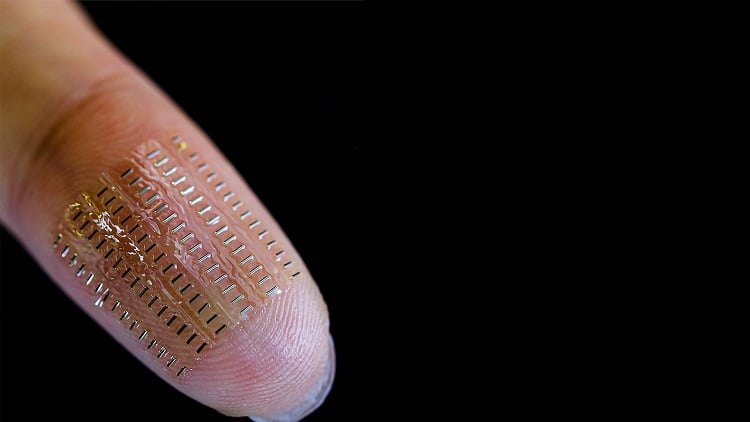
Researchers in Germany merged origami structure technology with microelectronics to design the smallest biosupercapacitor engineered to date. The biocompatible energy storage system broadens applications for intravascular implants and microrobotic systems for next-generation biomedicine that could operate in hard-to-reach small spaces deep inside the human body.
The smallest such energy storage devices engineered to date are larger than 3 mm3, but the new nano-supercapacitoris are 3,000 times smaller. The device features a volume of 0.001 mm3, occupies less space than a grain of dust and delivers up to 1.6 V supply voltage, roughly equivalent to that of a standard AAA battery, for microelectronic sensors. The flexible tubular geometry of the nano-biosupercapacitor provides efficient self-protection against deformations caused by pulsating blood or muscle contraction. At full capacity, it can operate a complex fully integrated sensor system for measuring blood pH.
Energy storage was satisfactory when tested in saline, blood plasma and blood. The nano-biosupercapacitor demonstrated excellent lifetime when tested in blood, holding up to 70% of its initial capacity even after 16 hours.
Scientists from Chemnitz University of Technology, the Leibniz Institute for Solid State and Materials Research Dresden and the Leibniz Institute of Polymer Research Dresden contributed to this development, which is described in Nature Communications.
