
The ever-shrinking footprint of computers and other electronics calls for the development of sub-millimeter-scale energy harvesters and storage devices. The realization of so-called smart dust applications, such as biocompatible sensor systems in the body, requires computers and batteries smaller than a dust mite.
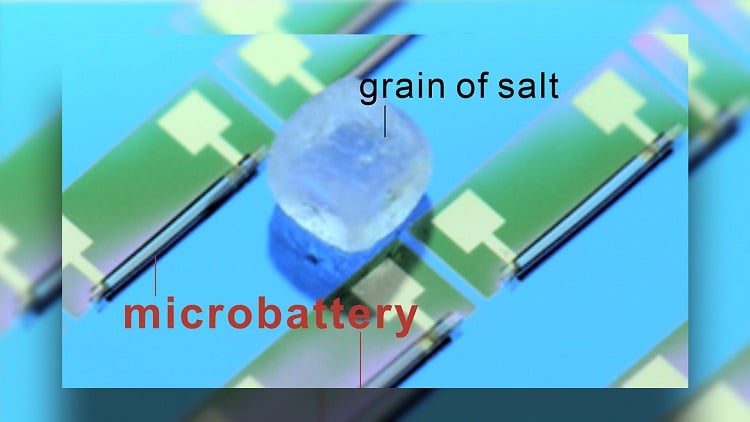
To meet this need for diminutive power devices, researchers from Germany’s Chemnitz University of Technology and Leibniz IFW Dresden have engineered a battery significantly less than one square millimeter across and integrable on a chip. The on-chip battery — the world’s smallest to date — still has a minimum energy density of 100 microwatt hours (μWh)/cm2.
A micro origami process was applied to layer current collectors and electrode strips made of polymeric, metallic and dielectric materials were layered onto a tensioned wafer surface. The inherent mechanical tension is released by peeling off the thin layers which then automatically snap back to roll up into a Swiss-roll architecture, negating the need for external forces to produce a self-wound cylinder micro-battery. The method is compatible with established chip manufacturing technologies and capable of producing high throughput micro-batteries on a wafer surface.
This assembly technique was used to fabricate rechargeable micro-batteries capable of powering the world's smallest computer chips for about 10 hours.
The battery technology outlined in Advanced Energy Materials offers great potential for powering nano-electronic sensors and actuator components in miniaturized medical implants, micro-robotic systems and ultra-flexible electronics.
