
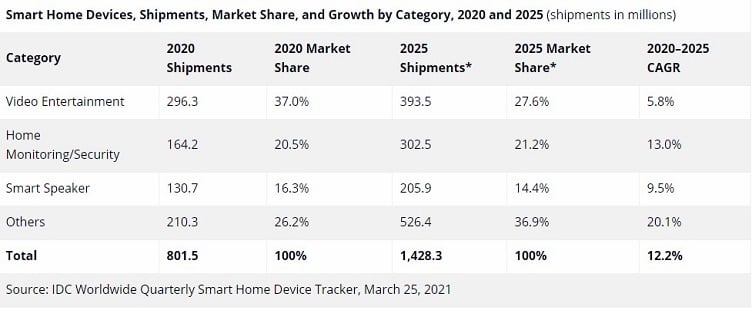
Due to continued lockdown measures caused by the COVID-19 pandemic, the market for smart home devices increased 4.5% in 2020 to reach 801.5 million units, according to new research from the International Data Corp (IDC).
IDC forecasts shipments for smart home devices to surpass 1.4 billion by 2025 with a five-year compound annual growth rate (CAGR) of 12.2%. The growth will be brought about by new home automation products and ambient computing through smart speakers and as other products continue to rise.
"Sales of smart home devices have remained fairly resilient during the global Covid-19 pandemic," said Adam Wright, senior research analyst for the smart home at IDC. "The market faced some challenges in 2020, the result of high unemployment, an uneven economic recovery and lockdown measures, among other factors. But nonetheless, 2020 saw positive year-over-year growth across all device categories.”
Wright said consumers shifted their spending from vacations, eating out or going to movies to focus on adding more comfort and entertainment at home. Because of this, streaming sticks, smart speakers, security devices, smart lights and other technologies performed well in 2020.
The U.S. will occupy the bulk of the unit shipments in the next several years and the region will grow at a CAGR of 3.8% during the forecast period with more than 451.3 million units shipped in 2025. China will be the second largest shipment in volume through 2023 and will overtake the U.S. by the end of 2024 with a CAGR of 21.9%. Canada and Western Europe will experience five year growth rates of 17.7% and 14.7%, respectively.
Entertainment devices are expected to be the largest volume of shipments, accounting for 27.6% of all shipments in 2025 as these devices increase in functionality such as 8K, higher refresh rates, HDR, larger sizes and integration of smart assistants and streaming platforms. Smart cameras and smart locks will account for 21.2% of the shipments in 2025 with a CAGR of 13.0%, IDC forecasts. But smart speakers and displays will slow over the next few years as the installed base of these devices reaches maturation and consumers look to other devices to access smart assistants in the home such as thermostats, appliances and TVs.
The full research can be found in IDC’s Worldwide Quarterly Smart Home Device Tracker.
