
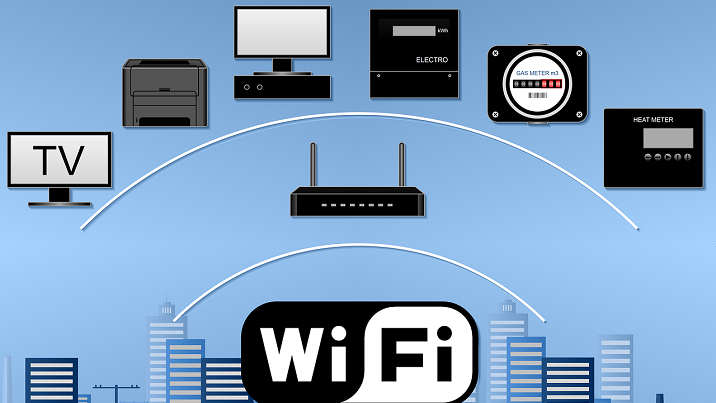
Simultaneously, 5G New Radio (5G NR) and Wi-Fi 6 are both emerging and aiming to provide higher bandwidth, more robust connectivity and massive amounts of connected devices. As such, they have become the key enablers of many smart solutions, including cloud-based virtual reality (VR), internet of things (IoT), remote robotics solutions and so forth.
Similarities of 5G NR and Wi-Fi 6
Consequently, the two are very similar, so much so that they might have some customers asking why they should have two network technologies in the air, when having just one of them might be good enough to take care of everything? With this assumption in mind, some customers, especially those in small enterprises, are starting to see that mobile network signals are pretty much everywhere (assuming they are in a big city). As a result, enterprise customers who see that 5G NR can provide a stable mobile broadband, up to 1 Gbps of bandwidth or more, wonder why they should maintain a separate Wi-Fi network infrastructure when leveraging 5G NR can shift the burden to mobile operators. It sounds so attractive to take advantage of the technology shift, but there is much more to consider.
5G NR cannot replace Wi-Fi 6
To simplify, the two network technologies are very different and they cannot replace each other; not now, not in the future. A key point raised by Wi-Fi solution providers in the field is that Wi-Fi is still the best option for indoor coverage, while 5G NR will be best for outdoor coverage. Despite this, there will still be customers who think that their good mobile signal indoors somehow invalidates the argument from Wi-Fi solution providers. Still, it does not mean that Wi-Fi can be replaced by a strong mobile network.
Let's take a deeper look at the reasons from a more scientific perspective.
Their differences matter a great deal
People not affiliated with the mobile network industry think the mobile signals received indoors are coming from the cell sites on nearby buildings, rooftop or hills. The fact is, they are coming from the indoor operator antennas. Depending on which location a customer is in, the major spectrum of 4G LTE used is in the range of 1,700 MHz to 2,600 MHz. It is the same as the home Wi-Fi band on 2.4 GHz that physically cannot go too far or that experiences a weakened signal when passing through obstacles.
So, while customers might already know that a 5G NR antenna can provide signal coverage with a range very similar to that of a typical Wi-Fi access point (AP), building indoor 5G NR coverage is much more expensive than building a brand-new Wi-Fi infrastructure. Fiber optics, base band units (BBU), remote radio unit (RRU), RRU hub (RHUB) and pico RRU (pRRU) are telecommunications-grade devices that are more expensive than the Wi-Fi AP and controllers. Sharing such an investment with the telco operator will definitely help the landlord to enable 5G NR on their properties much sooner, and they can also have more control over the details of the deployment. However, having a Wi-Fi infrastructure will give customers full control over the network at a much lower cost.
The technologies complement each other
5G NR is designed to use different spectrums for different purposes: the sub 1 GHz band is for better signal penetrations and more connected devices; sub 6 GHz is for low latency mobile broadband to the general public; and the millimeter wave (mmWave) in 26 GHz to 28 GHz will be used for critical solutions that need extreme speed and responsiveness. These are all licensed bands with better reliability and security, offering more possibilities such as network slicing, private 5G and telco application programming interface (API) integration. Also, all mobile network technologies, including 5G NR, are designed for seamless hand-off that even in a high-speed movement, the data transmission over 5G NR can remain stable and reliable.
Wi-Fi 6 on the other hand, is primarily an access technology that requires separate backhaul. It is on the unlicensed band, which is currently available on 2.4 GHz, 5 GHz, or later, and also on 6 GHz when Wi-Fi 6E is available, that anyone can use and occupy the bands anywhere with low cost. As such, interference will be a huge concern for critical missions relying on Wi-Fi, especially on the 2.4 GHz that many other network technologies like Bluetooth and Zigbee are all sharing.
While Wi-Fi provides a much simpler upgrade path to existing solutions, it also gives enterprises the full visibility of the whole network to control every aspect for their own benefits. Private 5G networks can achieve similar results, but its building cost can hardly be justified unless it is some highly critical solutions, like those for airports or the government.
Conclusion
There is no obvious winner between the two network technologies, which are designed for different use cases. Yet, there are some similarities between them, including that they both outperform their own previous generations, making wireless data communication more than just broadband, and they are both becoming more smart technology friendly. However, unless there is a reason to invest in a private 5G network, Wi-Fi 6 and its predecessors will still be the major wireless network technology for enterprises and corporations.
