
A nanoclip engineered by researchers from Boston University, GlaxoSmithKline (U.K.) and the University of Oregon is the first cuff electrode for recording or stimulating peripheral nerves to be fabricated on a scale compatible with the smallest nerves in the body. About the diameter of a human hair, the device could lead to the development of bioelectronic therapies that target chronic problems such as asthma or hypertension.
The nanoclip decodes and modulates electrical signals traveling in the peripheral nervous system, which 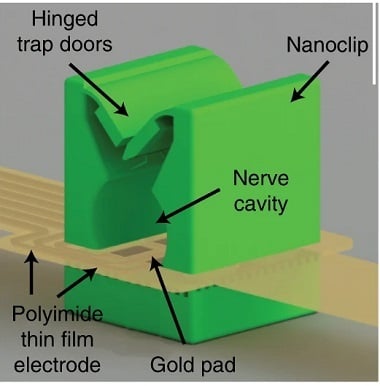 Rendering of a thin-film-integrated nanoclip nerve interface showing key components. Source: Timothy M. Otchy et al.contains nerves and neuronal cells outside the brain and spinal cord that control end organs. A 3D printer designed by the researchers was used to produce the devices and can manufacture them up to 20 times faster than existing commercially available printers that operate at a similar resolution.
The thin-film electrode with a 3D-printed housing was implanted in the peripheral nervous system of songbirds, where it successfully recorded electrical impulses that drive vocalizations. The device also allowed researchers to precisely control the output of the nerve and achieve distinct vocalizations for different spatial patterns of activation on six electrical contacts within the nanoclip.
This level of spatiotemporal control may be of value for biomedical implants designed to activate a nerve with spatial selectivity for specific structures that have different functions in the target organ. The device described in Nature Communications provides a new reference for safe implants, stable high signal to noise ratio recording over multi-week timelines and precise modulation of small peripheral nerves.

