
An injectable flexible electrode has been engineered to replace rigid electrodes, which do not mesh well with soft tissues, used in neuromodulation therapy. Administered as a liquid, the “injectrodes” offer a lower cost and 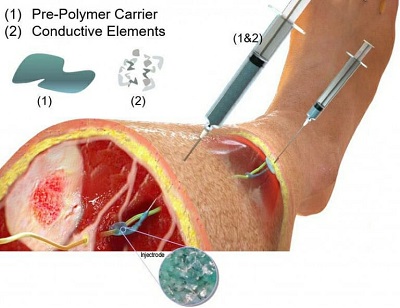 The researchers are testing a scheme in which they inject the fluid around the nerve, then extrude a thin insulated string of the material back to just underneath the surface of the skin, where they inject more of the composite material. Source: Neuronoff Inc.less invasive alternative to traditional implantable neuromodulation devices.
Neuromodulation therapy is an effective treatment for many diseases and conditions, including chronic pain and epileptic seizures, but entails insertion of expensive, rigid implants that are not compatible with receiving tissues. By contrast, the new material forms a flexible bolus when injected as a liquid, cures around a target nerve and serves as an electrically conductive interface that is orders of magnitude less stiff than conventional neuromodulation electrodes.
When tested with pigs, the performance of the silicone‐metal‐particle composite-based injectrode was comparable to that of standard wire electrodes used to stimulate the vagus nerve.
Researchers from University of Wisconsin, Mayo Clinic, University of Pittsburgh, Case Western Reserve University and Neuronoff Inc. are continuing to develop the injectable, conformable electrode to stimulate spinal nerves as a non-opioid alternative to treating chronic back pain. A simplified neuromodulation scheme being evaluated applies a basic transcutaneous electrical nerve stimulation unit to a channel of the injected material that leads from the target nerve to just underneath the surface of the skin.
