
Researchers from Texas A&M University created a smart device that can help utility companies serve communities affected by power weather brownouts.
The new device improves energy delivery between home solar power systems and the electrical grid. It allows solar energy consumers to be less dependent on the external power grid and utility companies can control energy distribution.
In homes with solar panels, the current generated by the panels is fed to an inverter before electricity is ready for residential use and charging solar back up batteries. Another set of power electronics connects to the solar panels and batteries and back to the grid. These connections ensure that homes are connected to the grid as long as the grid is working. Solar panel equipped homes consume more energy during the day and any excess energy created is supplied to the grid. At night, these homes draw electricity from the grid.
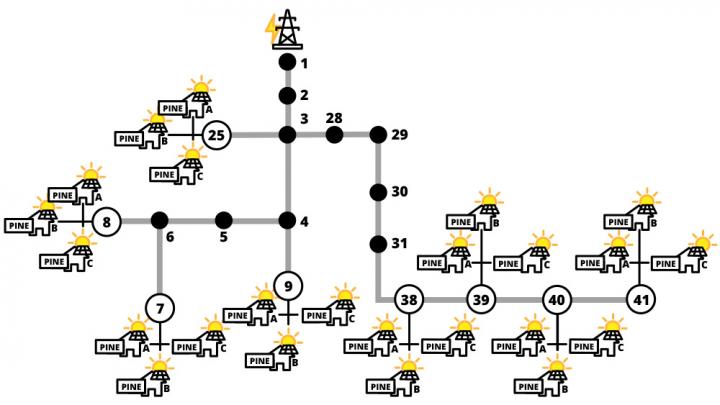 Mixed neighborhood used in the researchers' computer simulation. Open circles denote nodes where homes have PINE systems and dark, filled circles are nodes where homes do not have PINE. All homes receive energy from the grid. Source: Texas A&M University College of Engineering
There are many disadvantages to the conventional system. One issue is that grid voltage can fluctuate due to system faults or overloading. Electric utility companies can cap the residential electricity drawn in by a home to ensure critical services remain fully functional in the event of a brownout. Another issue is when a current is injected into the grid from solar-powered homes can cause harmonics, affecting the quality of the power in the grid. Currently, there is not a lot that a utility company can do to limit grid electricity consumed by solar-powered homes. This is harmful during natural disasters when emergency services need electricity the most.
To overcome these issues, the team created a single device called the power electronics intelligence at the network edge (PINE). PINE can be installed outside a home with three main connections; one going into the home, one going to the utility grid and one connected to the solar panels and batteries. PINE can control the flow of electricity to any of these areas.
PINE is like an intelligent energy router that regulates grid voltage, integrates solar energy and manages the route electricity. PINE is programmable. An authorized external user can control the amount of grid electricity reaching solar-powered homes. PINE systems installed in different homes can be programmed to communicate with each other and the distribution operator.
To test PINE, the team built a hardware prototype and created computer simulations of a neighborhood. Some of the homes in the virtual neighborhood were equipped with PINE and some were not. The results showed that homes with PINE had cleaner and more stable voltage than the homes without PINE. At the grid level, the injected voltage from homes was stable because PINE was regulating power. PINE allows homes to be self-sufficient and use solar power efficiently. Utility companies can wirelessly instruct PINE systems to limit the grid current to solar homes and redirect it when needed.
Read more about this project on the Texas A&M University website. A paper on this technology was published in the Engineer’s Journal of Emerging and Selected Topics in Power Electronics.
Editor’s note: This story was updated on 08/27/2020 to correct an inaccuracy.
