
Researchers from the University of Rochester are developing a way to address the world’s water crisis using sunlight to evaporate and purify contaminated water with greater than 100% efficiency.
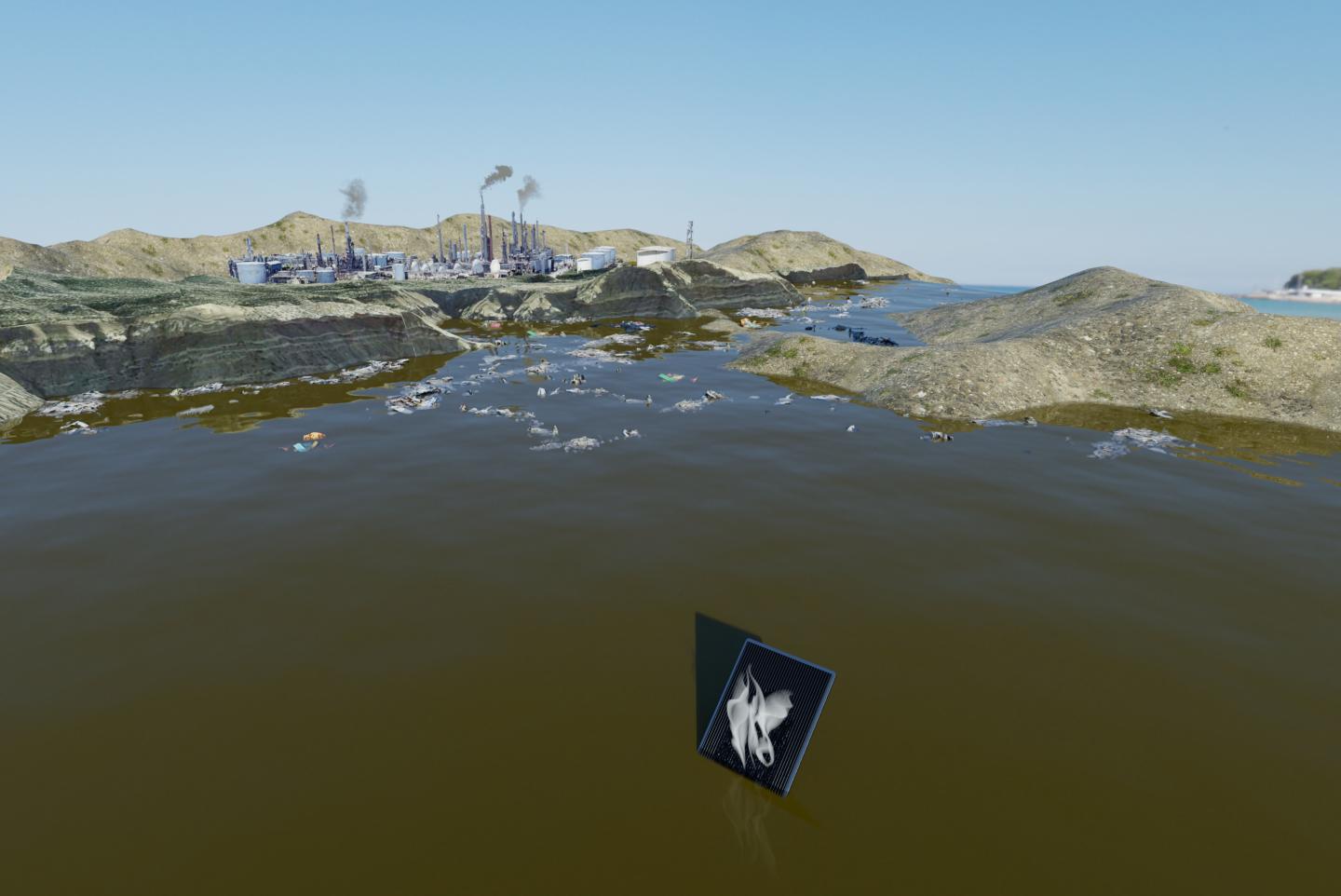 A laser-etched, energy absorbing, water-wicking metal surface, continually angled directly at the sun, provides a cheap, efficient way to purify water from sunlight. The technology was developed by the lab of Chunei Guo at the University of Rochester. Source: H.M. Cao/University of Rochester
With the new method, bursts of femtosecond laser pulses etch the surface of a normal sheet of aluminum, turning it into a super wicking, super energy absorbing material. The material’s abilities are enabled when it is angled, facing the sun and drawing a thin film of water upwards over the metal’s surface. This material retains nearly 100% of the energy it absorbs from the sun and quickly heats water. At the same time, it is changing the intermolecular bonds of the water and increasing the efficiency of the evaporation process.
Experiments with the new material proved that the method reduces the presence of all common contaminants, like detergent, dyes, urine, heavy metals and more to create safe drinking water. This technology would be useful to relieve water shortages in drought-stricken areas and water desalination projects. Using sunlight to boil water can eliminate microbial pathogens and reduce death from diarrheal infections, but it doesn’t completely eliminate heavy metals and contaminants.
With solar-based water purification methods, contaminants in water are removed because nearly all impurities are left behind after the water has evaporated and the impurities are then collected.
A common form of solar purification is volume heating in which the largest volume of water is heated. But it is inefficient because only the top layer evaporates and only a fraction of the heating energy gets used.
Another kind of solar purification is interfacial heating, which involves plating made of a multi-layered absorbing and wicking material that lays on top of the water so only the water near the surface has to be heated. But all of the materials have to float horizontally and not directly facing the sun for this method to work. However, this method is less energy-efficient and materials become quickly clogged with contaminants after evaporation and needs frequent repair.
The new panel combines the efficient parts of these methods while avoiding their inefficiencies. It pulls a thin layer of water out of the reservoir and deposits it directly onto the solar absorber to be heated and evaporated. It is easy to clean and can be used continuously at any angle as the sun moves.
The team also created metallic structures that do not sink no matter how often they are forced into the water and even if they are damaged or punctured. The femtosecond laser pulses can also turn almost any metal pitch black. It creates surface structures that are effective at capturing incoming radiation in a broad range of wavelengths. The team has used a similar process to change colors of various metals.
A paper on this research was published in Nature Sustainability.
