A new approach to the detection of multiple heavy metals dissolved in water could be applied on-site and in real time. This type of water analysis could be of value in agricultural, pharmaceutical, water purification and other industries to monitor water for contaminants. Sound waves are used to levitate water droplets which then evaporate, concentrating the sample for spectroscopic analysis of harmful heavy metal contaminants such as lead and mercury in water.
The analysis is performed by laser-induced breakdown spectroscopy (LIBS). Levitating the water droplets 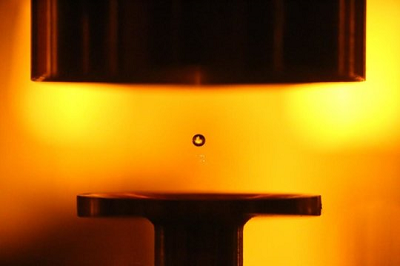 Sound waves are used to levitate droplets of water which then evaporate, concentrating the sample for spectroscopic detection of heavy metal contaminants in water. Source: Jairo Peralta and Victor Contreras, UNAMallows the water to evaporate in a controlled position, which increases the mass concentration of contaminants in the sample. This approach was demonstrated to reliably detect very low levels of heavy metals with analysis times of just a few minutes, including 0.7 mg/l of cadmium and 0.2 mg/l of barium.
LIBS provides a fast and straightforward way to identify several elements simultaneously. The method focuses a high energy laser pulse onto a sample, which vaporizes the material and generates a plasma. Because the light emitted by the plasma contains the atomic fingerprints of the material, it is possible to identify the chemical components of the sample by analyzing the emitted light.
LIBS analysis is commonly used on solid samples, but it is difficult to apply to directly analyze liquids because the plasma formed in liquids cools down faster and lasts a very short time. In addition, producing a plasma on a liquid surface produces water splashes that directly affect the spectroscopy reading.
With liquid samples, creating a plasma that provides a good signal for chemical detection requires high levels of laser energy, which can only be provided by bulky, non-portable lasers. To circumvent this problem, liquid samples are typically analyzed by placing a drop on a substrate and waiting for it to dry in order to concentrate the elements of interest in the sample. Although depositing the sample on a substrate is quite simple, the laser pulse excites atoms from elements in the sample as well as from the substrate. Water evaporation could also lead to inhomogeneous distribution of the impurities on the substrate, compromising its signal reproducibility.
Instead of depositing the droplets onto a substrate, the researchers used intense sound waves to levitate single droplets of water. The sound waves produce a force strong enough to counteract gravity, allowing a droplet to hover unsupported in the air.
The researchers are now optimizing the mechanical design of the acoustic trap to achieve more stable levitation conditions, which will improve the reproducibility of the LIBS readings. They also want to increase the sensitivity by stably levitating smaller drops, which further concentrates the contaminants. This is a key step toward miniaturizing the device because it will allow the use of less sensitive but more compact detectors.
Scientists from Universidad Nacional Autónoma de México, Centro de Investigaciones en Óptica A. C. Loma del Bosque and Universidad Autónoma del Estado de Morelos contributed to this research, which is published in Optics Letters.