
Sponsored Content
Wireless Connectivity
Challenges and solutions of Wi-Fi 6 for design engineers
28 January 2020
Sponsored content
Demand for better wireless signals has increased with larger networks and connected devices. Wi-Fi has also increased in speed, allowing more connections through improvements in frequency used and data transmission. Cellular data has also become influential since it works over a wider area. These changes create opportunities for Wi-Fi to continue as a backbone in both residential and commercial applications.
As cellular data rates have improved and are now moving to 5G, it may seem that Wi-Fi is less important. Even with 5G, cellular data has less capacity than what home networks typically provide. When lots of users are on a Wi-Fi network, cellular data may seem better due to congestion. Wi-Fi 6 (802.11ax) aims to address this issue.
Coverage, capacity, use and setting
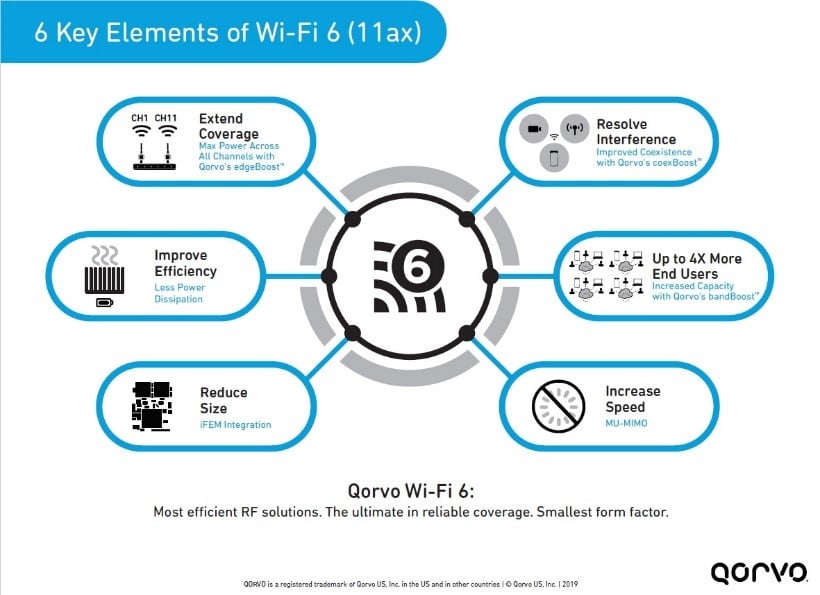 Figure 1: Key elements of Wi-Fi 6. Source: QorvoSome of the current limitations of Wi-Fi are related to its coverage, capacity and how many users it can support. Wi-Fi 5 data rates are good for small networks but are still slower than wired connections and become worse when multiple users are on. The continued growth of smart devices will worsen this problem. Network coverage and how far a network works is another issue. Inside a building signals do not penetrate walls well and outside networks simply do not go far enough.
The internet of things (IoT) is substantially increasing the number of devices connected to a network. IoT devices are not in constant communication, but “wake up” as data is required. Some IoT devices, like cameras, require more bandwidth, but others, such as thermostats, do not. Current Wi-Fi 5 systems treat all wireless connections the same, slowing networks with many devices. Wireless use indoors versus outdoors is not often the same: indoor wireless is short-range but may need to cover multiple rooms or directions. Outdoor wireless must travel greater distances and is often line-of-sight, yet Wi-Fi 5 does not distinguish settings.
Wi-Fi 6 changes from Wi-Fi 5 and older
Wi-Fi 5 uses orthogonal frequency division multiplexing (OFDM), while Wi-Fi 6 uses orthogonal frequency division multiple access (OFDMA) designed for multiple users in mind. These differ in how packets of information are carried on a network. With OFDM, the packets have fixed sizes regardless of the data sent, and OFDMA has smaller packets that can be split between users. This allows more efficient use of the packets so that devices receive only what they need.
Multiple-input multiple-output (MIMO) used in Wi-Fi 5 allows for only a pair of wireless devices to simultaneously send and receive multiple data streams. Data is shared by splitting up the time spent talking to each device. MU-MIMO is the multiple user version of MIMO in Wi-Fi 6 and expands on MIMO by allowing multiple devices to transceive streams at the same time.
Quadrature amplitude modulation (QAM), used in Wi-Fi 6, is a method of digital transmission. Going from 256 to 1024 QAM increases the data capacity by about 25% by increasing the bits per symbol from eight used in 256 QAM to 10 in 1024. This increase allows for a theoretical single stream data rate of 600 Mb/s where Wi-Fi 5 had a theoretical 433 Mb/s single stream rate.
Wi-Fi 6 is also expected to have a new frequency spectrum. Current Wi-Fi signals operate in the 2.4 GHz and 5 GHz range. The exact frequency range varies by country and this will be true of the new spectrum as well. In Europe, the range may go up to around 6.4 GHz, while in the United States it may go into 7 GHz. The expanded spectrum will allow for more or wider channels to further enhance transmission.
Power amplifiers and additional requirements for Wi-Fi 6
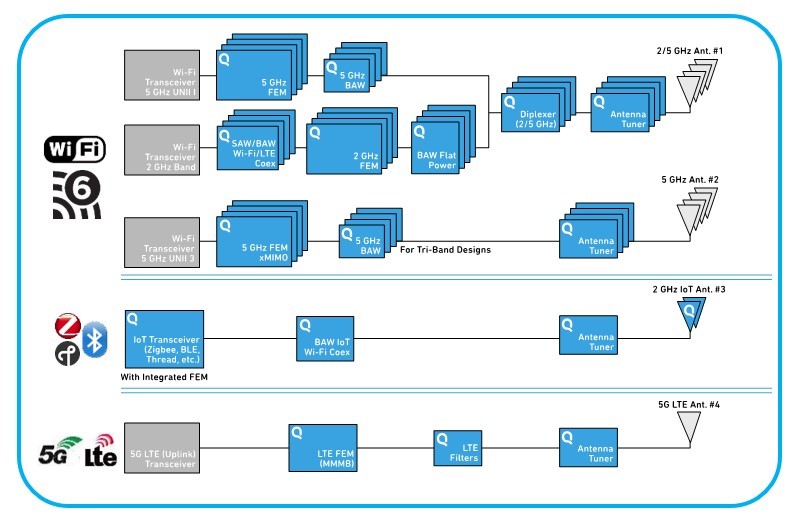 Figure 2: Triband architecture. Source: QorvoThe enhancements for Wi-Fi 6 require new hardware. One of the requirements is on the amplifier section where higher linearity and a flatter response curve is necessary, as well as a lower noise figure for low noise amplifiers (LNA). Accomplishing this requires better designed RF components and filters.
Another challenge is efficiency and thermal considerations. More advanced processing and RF requires power and creates heat, and building wireless equipment into a compact pleasing form-factor makes thermal management more difficult. Also related is power efficiency, which becomes a major factor with limited power like 3.3 V and power over ethernet (POE) systems.
FEM use and advantages
A system on chip (SOC) used with assorted Wi-Fi equipment performs many functions. On Wi-Fi 6 it is doing all the modulation, encoding, decoding, RF and other functions. SOCs are made with processing in mind and with semiconductor materials that are best suited for that. A SOC is not the ideal RF device to provide the requirements and power that Wi-Fi 6 needs for power amplification. Front end modules (FEM) are a specific designed RF section that can integrate with a SOC to provide power amplification with increased efficiency and better RF.
One important aspect of RF power amplifiers is filtering. RF amplification circuitry often does not have a completely linear response. Filtering can selectively block unwanted frequencies and reduce power levels at specific frequencies to make the response more linear.
Designers do not always have control over a device’s power characteristics. For USB or internal devices, the voltage may be 3.3 V or 5 V with limited current. Tied in with this are thermal issues since more power causes more heat that needs to be dissipated, which takes space. Ideally, designs are efficient and use as little power as necessary. This is one area where FEMs help: their materials are inherently more efficient at amplifying and filtering RF, versus a SOC amplifier.
Size and aesthetics are another factor that ties into the power and thermal issues: heat sinks take up space and limit designs, and consumer designs often demand power supplies that are sleek and pleasing. The inclusion of a FEM aids in this by reducing heat sink size, enabling designs to be more compact and in a wider range of shapes.
Qorvo
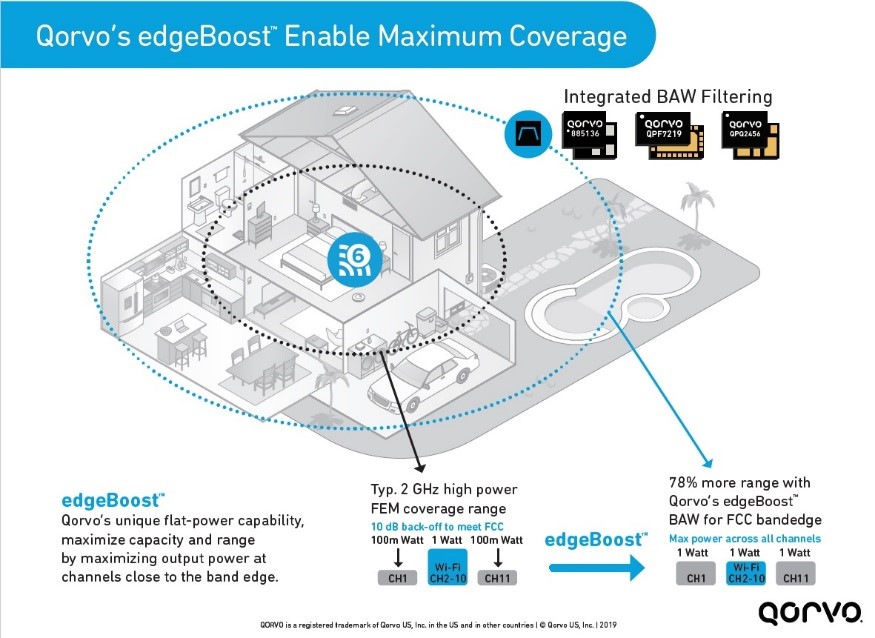 Figure 3: Qorvo’s Edgeboost™ for enabling maximum coverage. Source: QorvoQorvo makes FEMs that are designed for the future of Wi-Fi 6 and other RF needs. They use a filter designed by them called a bulk acoustic wave (BAW) filter. The BAW filter has better performance compared to the more common surface acoustic wave (SAW) filter that is often used in similar applications. The BAW filter allows for a flatter response and better channel separation for a better signal at greater distances.
Qorvo has an integrated FEM that combines multiple functions such as a BAW filter, PA, LNA and RF switch integrated into a single device. This integrated approach means fewer components, reduced requirements for tuning elements and loss, and ease of use supporting faster time to market. Integration also increases efficiency and reduces thermals from such things as trace losses. This is all done in a package size on par with a non-integrated device, saving valuable board space.
Conclusion
As RF technology advances and the number of devices connected to the internet increases, so will FEM needs. SOC designs that contain transceivers, which include technologies such as Zigbee and Wi-Fi, will continue to require better RF.
Qorvo’s iFEM is a great way to solve this. Contact Qorvo for help picking out an application-specific FEM.
Powered by CR4, the Engineering Community
Discussion – 0 comments
By posting a comment you confirm that you have read and accept our Posting Rules and Terms of Use.
Advertisement
Advertisement
Popular News
Find Free Electronics Datasheets

Advertisement