
Researchers from Duke University have created a deep learning neural network that reveals how it is thinking. The team trained the network to identify up to 200 species of birds in one photo and tell the team how it identified each bird.
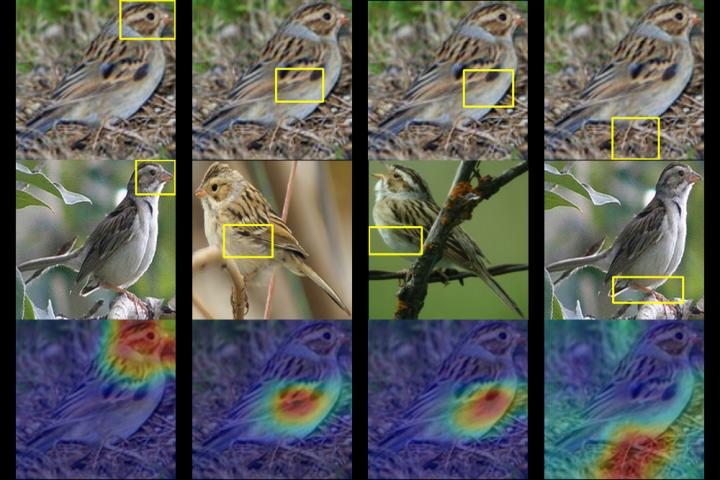 A Duke team trained a computer to identify up to 200 species of birds from just a photo. Given a photo of a mystery bird (top), the A.I. spits out heat maps showing which parts of the image are most similar to typical species features it has seen before. (Source: Chaofan Chen, Duke University)
The network was trained on 11,788 photos of 200 bird species. The images ranged from swimming ducks to hovering hummingbirds. The team never told the system what a beak or a wing was. The system independently learned the characteristics of each bird species by comparing the patterns seen in other images. The network was able to identify the correct species 84 percent of the time, which is on par with its counterparts.
The difference between this system and its counterparts is its ability to reveal how it is thinking. Because most systems learn from data without having to be programmed to do so, the process of how they learn is vague. The team wanted to create a system that would reveal what is thinking while looking at an image. To achieve this, the team used the same technology that is used to tag faces on social media or find suspected criminals in surveillance images or train self-driving cars to detect pedestrians or traffic lights. The system is able to show how it is analyzing an image. When the system makes a mistake, it can show researchers where it went wrong.
In the future, the team wants to use this technology to classify suspicious areas in medical images. For example, the deep learning network can help doctors detect breast cancer in mammogram images by identifying lumps, calcifications and other symptoms. It shows doctors what areas of the image it is focusing on to find features that the system has seen before in other mammogram images.
A paper on this technology will be presented at the Electronic Proceedings of Neural Information Processing Systems Conference in December 2019.
