
Retinal diseases in adults are commonly detected with tabletop optical coherence tomography (OCT) systems. The use of these devices for ophthalmic imaging in infants and children is a challenge, due to the need for stable patient positioning. A miniature, handheld probe capable of delivering high-speed OCT scans and reducing examination time windows has been designed for pediatric applications by an international research team.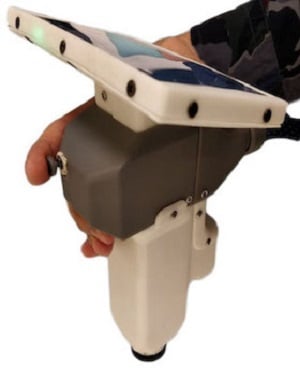 The hand-held ophthalmic OCT system. Source: University of Washington
The portable OCT system includes a 200 kHz swept-source laser supplied by Axsun Technologies. Features engineered to support infant imaging include a direct-view iris camera incorporated into the hand-held probe, an on-probe display for the operator when performing imaging and on-probe controls allowing the control of motorized optomechanical components. The instrument affords a scanning angle of ± 36° on the pupil with 3D OCT and OCT angiography scan times of 0.8 and 3.2 seconds, respectively.
The probe was demonstrated to be capable of providing capillary-level resolution OCT angiography images when tested on adult volunteers and premature infants. The prototype hand-held device proved more comfortable and efficient for operators due to the introduction of the iris viewer and the visual feedback available from the on-probe display when positioning it.
Future improvements to the field-of-view on the infant retina are planned, as are enhancements to imaging speed and the capacity for real-time front-facing viewing of the infant's fundus. A paper on the research conducted by scientists from the University of Washington, the University of Dundee (Scotland) and Sichuan University (China) is published in Biomedical Optics Express.
