
Brain injury or hydrocephalus — too much cerebrospinal fluid on the brain — cause high intracranial pressure (ICP) in infants. This parameter is typically monitored by palpating the soft spot on the pediatric patient’s skull, which does not provide the most precise results, or by obtaining more accurate data by drilling and inserting sensors. A non-invasive means of securing meaningful ICP data was developed by Rice University engineering 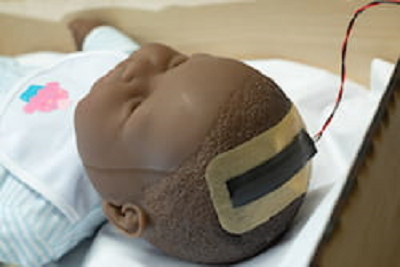 The system monitors high ICP within the skulls of infants, a condition that affects more than 400,000 every year. Source: Jeff Fitlow/Rice Universitystudents.
The Bend-Aid is a flexible device based on a wound dressing already in common use with an embedded ribbon-like sensor. The device is placed over the anterior fontanelle, the soft spot between an infant’s skull bones, where it can stay for up to a week. The sensor continuously monitors pressure at the site and transmits data to a processing unit as the fontanelle changes shape or bends, which can be correlated with ICP.
The prototype includes an alert system that issues an alarm when ICP reaches abnormally high levels and a data storage module that records data sets at given time intervals for at least seven days. Bend-Aid offers the potential to replace catheter insertion and fontanelle palpation options and to deliver accurate ICP measurement in a non-invasive way.
