
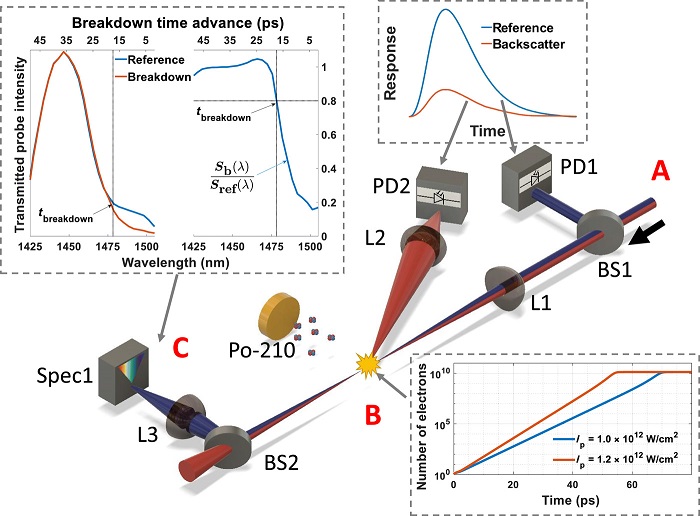
 (A) Copropagating 50-ps (FWHM) λ = 3.9 μm pump and 70-ps (full width) chirped 1.45-μm probe pulses are generated in an OPCPA system. (B) Ionizing radiation (5.3-MeV α-particles) from an 18-mm-diameter Po-210 foil source generates a population of free electrons and O2− ions in the focal region of lens L1, seeding collisional avalanche ionization driven by the λ = 3.9 μm pump. The evolving avalanche breakdown plasma backscatters a portion of the λ = 3.9 μm pump pulse, which is collected by lens L2 onto PbSe photodetector PD2, with a sample trace shown. (C) The chirped λ = 1.45 μm probe is transmitted through the plasma, separated from the 3.9-μm pump by and collected by lens L3 onto InGaAs spectrometer Spec1. Source: University of Maryland
Available methods for detection of concealed radioactive materials are limited by time and distance, as Geiger counters and similar tools must be deployed within proximity of the target and measurement accuracy declines with radioactive decay. A new infrared laser beam-based detection system offers increased inspection precision since it can be deployed remotely.
The method engineered at the University of Maryland uses mid-infrared laser-induced avalanche breakdown of air. Decay particles emitted by radioactive material ionize atoms in the air, forming free electrons that quickly attach to oxygen molecules. These electrons detach from the oxygen molecules under the focused laser beam and generate an avalanche-like rapid increase in free electrons that is easily detected.
The air in the laser's path begins to ionize and exert a strong effect on the infrared light reflected, or backscattered, toward a detector. The onset and progress of ionization are gauged by tracking these changes. Determining the amount of radioactive material present in the target rests on estimating how many seed electrons were available to initiate the avalanche.
The proof-of-concept method described in Science Advances could lead to practical applications to enhance security at ports of entry worldwide.
