
The remarkable navigational abilities of desert ants have already inspired a team at the West Virginia University Interactive Robotics Laboratory (IRL) to name an award-winning autonomous rover after the genus designation of the six-legged creatures: Cataglyphis. Members of one species in the Sahara can sustain body temperatures up to 50° C (122° F) as they forage over hundreds of meters for food – other insects that have died from heat exhaustion – before having to quickly scurry back to their underground nests to avoid burning up themselves.
The ants apparently use the sun as a sort of celestial compass. By taking a bearing on its polarized light at each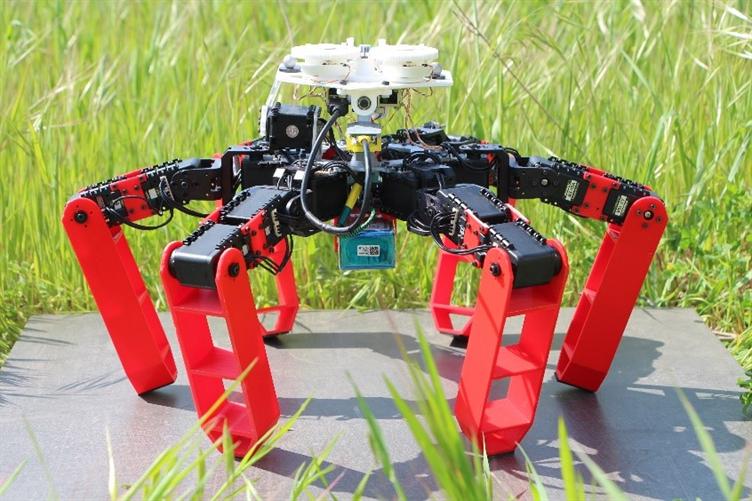 AntBot is modeled after another six-legged creature with remarkable navigational abilities. Source: Julien Dupeyroux, ISM (CNRS/AMU) zig-zag movement of their outward journeys, counting their steps and calculating their relative rate of movement, they are able to use the data they gather to compute a precise path to make a maximum-efficiency, straight-line return.
Now, AntBot, designed by the French National Center for Scientific Research (CNRS) and researchers at Aix-Marseille University (AMU), takes its cue from the ants to walk without using GPS. An optical compass with sensitivity to polarized radiation is used to determine heading with a 0.4° precision; an optical movement sensor directed to the sun measures distance covered.
With six feet enabling increased mobility in complex environments, the robot has demonstrated an ability to explore its environment and return to its base within a precision of 1 cm. Additionally, its compass is composed of just two pixels topped by two polarized filters. Those filters can be mechanically turned to provide the equivalent of far more expensive optical sensor composed of two rows of 374 pixels.
The research appears today in the journal Science Robotics.
