
Cell sorting plays a fundamental role in molecular biology, pathology, immunology and virology research. It requires the ability to rapidly search through and sort out cells based on their unique chemical features and shapes. Conventional methods are limited in uncovering these differences. These methods are often too labor- or time-intensive or require a tradeoff between speed and accuracy.
The Department of Chemistry at the University of Tokyo has developed an intelligent Image-Activated Cell 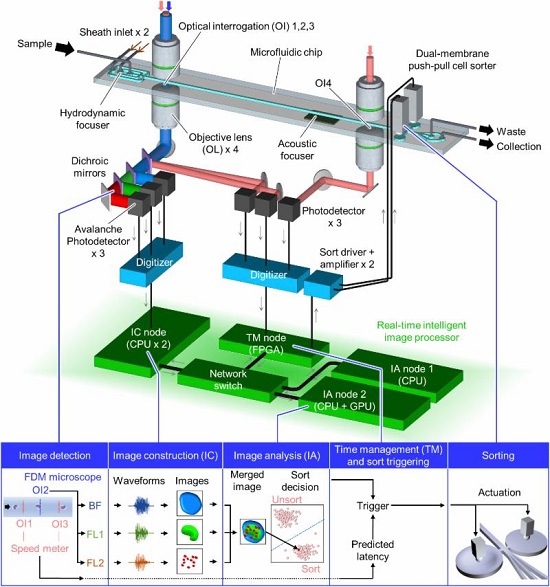 Source: SpectrumSorter (IACS) with an ultra-fast Spectrum Instrumentation digitizer at its heart. The image-based cell-sorting technology can process cells with enhanced throughput and accuracy and is expected to support machine-based, scientific discovery in biological, pharmaceutical, and medical sciences and, in particular, cancer where it could sort for the slight differences between cancerous and non-cancerous cells.
IACS uses real-time, machine intelligence technology to provide a new data management infrastructure, allowing cells to be accurately and rapidly sorted. IACS combines high-throughput cell imaging, cell focusing and cell sorting with a unique software-hardware data management infrastructure. The flexible and scalable system delivers real-time, automated operation for data acquisition, data processing, decision making and sort actuation. Even when using complex learning algorithms, the complete process is performed in just 32 m/s per cell.
A crucial part of the IACS setup involves image construction and relies on a frequency-division-multiplexed (FDM) microscope, which was also developed at the university. The FDM microscope can produce continuous, high-speed, blur-free, sensitive bright-field and two-color fluorescence image acquisitions of cells flowing at 1 m/s. This is required to achieve the system's breakthrough processing rate of around 100 cells per second.
[Learn more about imaging equipment at Engineering360.]
The other key to this ultra-fast cell sorting is the acquisition of signals that come from avalanche photodiodes in the FDM. This is done by passing the signals to a Spectrum M4i.2212-x8 digitizer card running at a sampling rate of 1.25 GS/s. The acquired data is then transferred over the card's high-speed PCIe bus to a PC where the spatial profiles, which are contained in the digitized waveforms, can be separated. The fast PCIe interface of the digitizer allows this process to run continuously with a high event rate. The separation process involves working in the frequency domain by performing Fourier transforms, which reveal each signal's distinct modulation frequencies.
Once the image construction is complete, the results are transferred using 10 Gb Ethernet to the image analysis and time management stages of the IACS. A field-programmable gate array, three central processing units, a graphics processing unit and a network switch combine to perform the necessary image processing and decision making using deep learning techniques on a neural network.
