
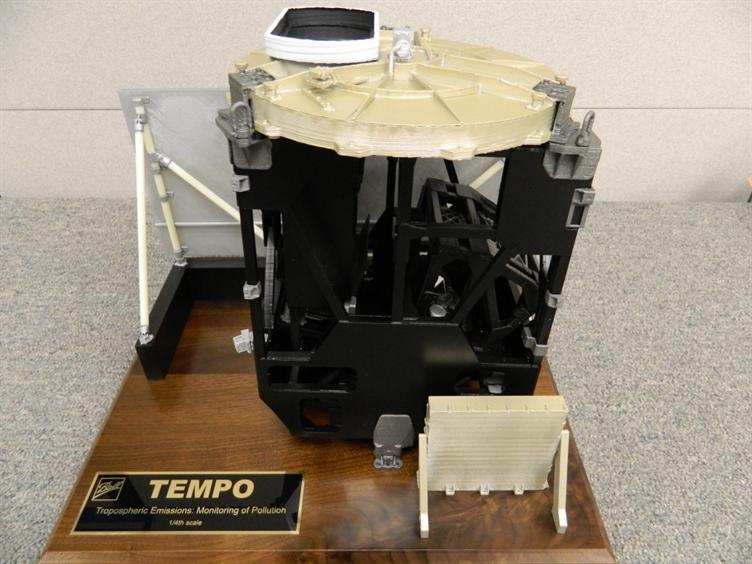
Monitoring air pollution from Earth’s orbit is the goal of TEMPO, an instrument NASA designed in partnership with Ball Aerospace and Technologies Corporation.
TEMPO, which stands for Tropospheric Emissions: Monitoring of Pollution, is a grating spectrometer that is sensitive to both visible and ultraviolet wavelengths of light. Ball Aerospace put TEMPO through an environmental test campaign to prove its ability to survive both the challenges related to launch and sustained operations in geostationary orbit. According to NASA, it will be the first space-based instrument to provide hourly daytime monitoring of major air pollutants across the North American continent.
[Discover UV and visible spectrometers on Engineering 360.]
TEMPO’s detection of ozone, nitrogen dioxide and other key pollutants is achieved by measuring sunlight reflected and scattered from the Earth’s surface and atmosphere. Pollution tracking at sub-urban scales is made possible by the instrument’s high spatial-resolution optical system, which resolves a few square miles per pixel, a significant improvement over previous limits of approximately 100 square miles.
As seen in the diagram below, RF wireless technology also plays a role in TEMPO's functionality. The device can send gathered signals back to a ground-based operations center (at a location to be determined), and from there to a science data processing center at the Smithsonian Astrophysical Observatory in Boston. While the device will be situated for tracking pollution above North America, it is designed to work within a global system of satellites that will enable scientists to confirm pollution trends around the world.
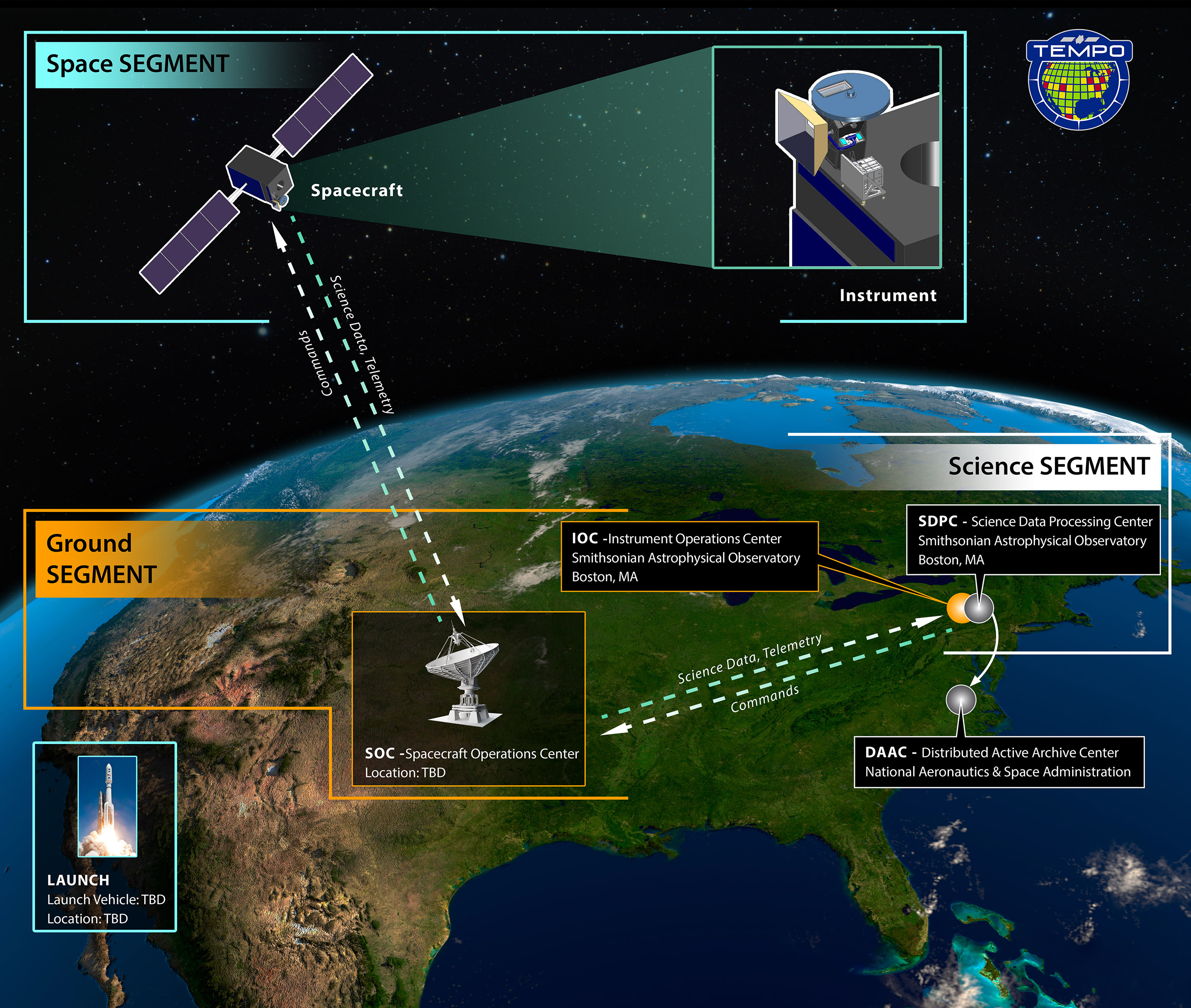 TEMPO operations architecture. Source: NASA Langley Research Center
The instrument has the potential to improve air quality prediction accuracy by 50%, enabling effective early public warning of pollution events. In addition, there is a public outreach aspect to the project. The TEMPO mission includes building a network of museums and public gardens across the country to engage learners in hands-on activities and develop their citizen science skills. This will enable the contribution of quantitative and qualitative data on local air quality, adding to the mission's impact on the overall scientific community.
Next up for TEMPO will be deployment at about 22,000 miles above Earth’s equator. NASA will partner with the U.S. Air Force's Space and Missile Systems Center (SMC) in El Segundo, California, to issue a request for proposals from commercial companies that can provide satellite integration, launch services and ground operations.
TEMPO is the first instrument to be funded by NASA’s Earth Venture Instrument (EV-I) program, a component of the agency’s Earth System Science Pathfinder Program (ESSP). The EV class of missions consists of projects that are low-cost, principal investigator-led and built, tested and launched in short time intervals. TEMPO’s development team includes the Smithsonian Astrophysical Observatory (SAO); NASA’s Langley Research Center and Goddard Space Flight Center; the U.S. Environmental Protection Agency (EPA); and various U.S. universities and research organizations.
