
Emerging 3D nanoprinting systems have been used to fabricate medical devices on the nanoscale, but cost and complexity issues make the technology impractical for most applications. An improved approach to the synthesis of 3D printed microfluidic circuitry has been engineered at the University of Maryland.
The sol-gel-based in situ direct laser writing technique enables 3D nanostructured designs to be printed inside 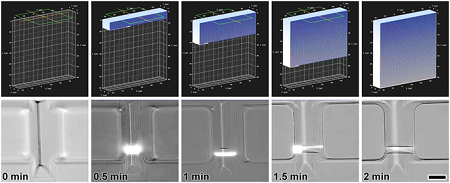 Sequential computer-aided manufacturing simulations (top) and corresponding in situ direct laser writing fabrication results (bottom) for printing a 10 μm thick microfluidic barrier wall structure. Source: University of Marylandof, and fully sealed to, polymer-on-glass microchannels. The researchers 3D printed a microfluidic helical coil spring diode with improved flow rectification performance at higher pressures. The fully sealed, 3D microfluidic diode was produced at a fraction of the cost and in less time than previous approaches.
Printing the diode structure layer by layer directly inside of the channel results in a strong seal that will protect the circuit from contamination and ensure any fluid pushed through the diode is released as desired. The device featured 10 μm thick barrier wall structures sealed to microchannels with heights of 10, 25, 50 and 100 μm.
Demonstration of the 3D microfluidic diode could serve as a baseline for a new generation of microfluidic circuit elements constructed by means of the in situ direct laser writing process. The research is published in Scientific Reports.
