
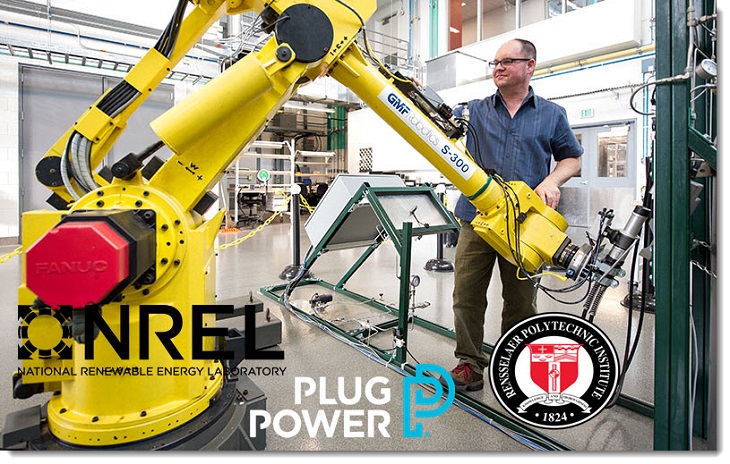
 The robotic fueling station is designed to increase the ease and efficiency of fueling hydrogen-powered vehicles in warehouse settings. Source: Plug Power
The efficiency and safety of fueling hydrogen-powered vehicles used in warehouses is set to increase with the advent of a robotic hydrogen fueling station. A pilot feasibility trial confirmed the ability of the system to autonomously couple a fuel cell to the fueling station without assistance from a human worker.
The robotic fueling technology was developed by Plug Power Inc., the U.S. Department of Energy’s (DOE’s) National Renewable Energy Laboratory and the Rensselaer Polytechnic Institute (RPI) Center for Automation Technologies & Systems. RPI students contributed to the engineering of computer vision, sensors, robotic manipulation of the fueling nozzle and remote control capabilities.
The automated fueling system can be easily integrated with existing Plug Power GenFuel hydrogen storage and dispensing sites. The researchers cite applications in on-road fleet vehicles, autonomous guided vehicles and self-driving passenger cars in the future.
To realize these goals, the researchers will use a $2 million grant from the DOE Office of Energy Efficiency and Renewable Energy to develop a commercially viable autonomous hydrogen fueling station, with additional technology development including data exchange, interconnection interfaces and robotic equipment.
