
Sponsored Content
New Technologies Impacting the Smart Factory
11 September 2018
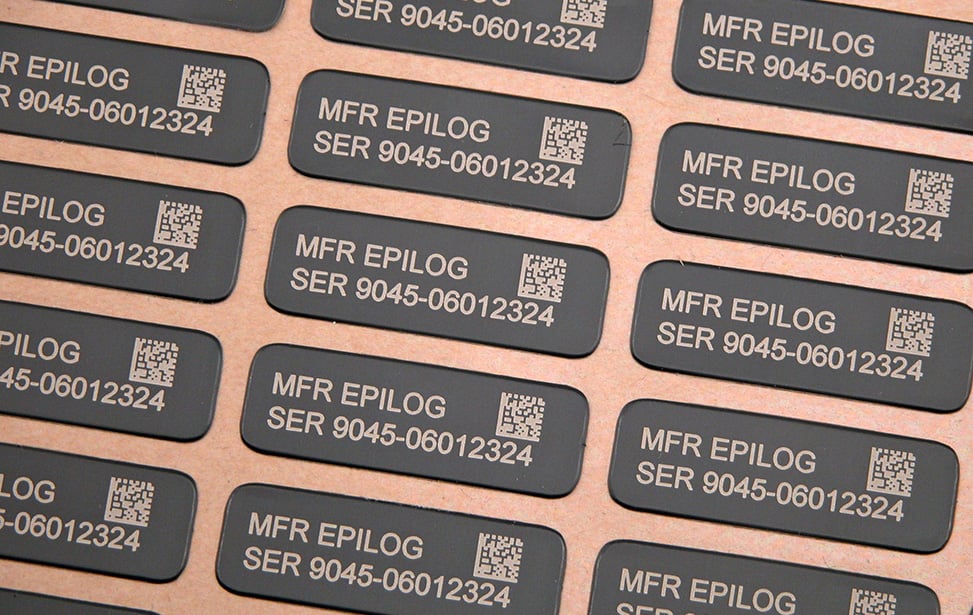 A laser's ability to mark products with a specific code or ID brings value-added features to a smart factory, and is a way to prevent counterfeiting of materials. Source: Epilog
Sponsored content
Not all factories are ready to go the way of lights-out manufacturing, where autonomous robots occupy a factory and don’t require lights at all; where it is just rows of machines functioning in the dark.
But that doesn’t mean technology isn’t changing and influencing the way a modern factory operates and what products it can create. From the industrial internet of things (IIoT), to 3D printing, to robotics, to the rising use of industrial lasers, integrating new technologies into a factory makes manufacturing more autonomous, cheaper and more efficient.
IIoT is seen as a game changer for the modern factory. Connected factories are capable of monitoring and controlling virtually anything in the manufacturing process, and can be managed either from the factory floor or remotely. Connectivity accelerates automation and also enables manufacturing to take advantage of cognitive analysis, machine learning and big data, providing insight into the efficient manufacturing for various devices and optimization of equipment maintenance and use. The overall result is effective factory management that both increases quality assurance and mitigates costs. By 2020, according to market research firm Gartner, IoT tech will be included in 95 percent of all electronics for new product designs, including the use of IoT in the industrial space to build these devices.
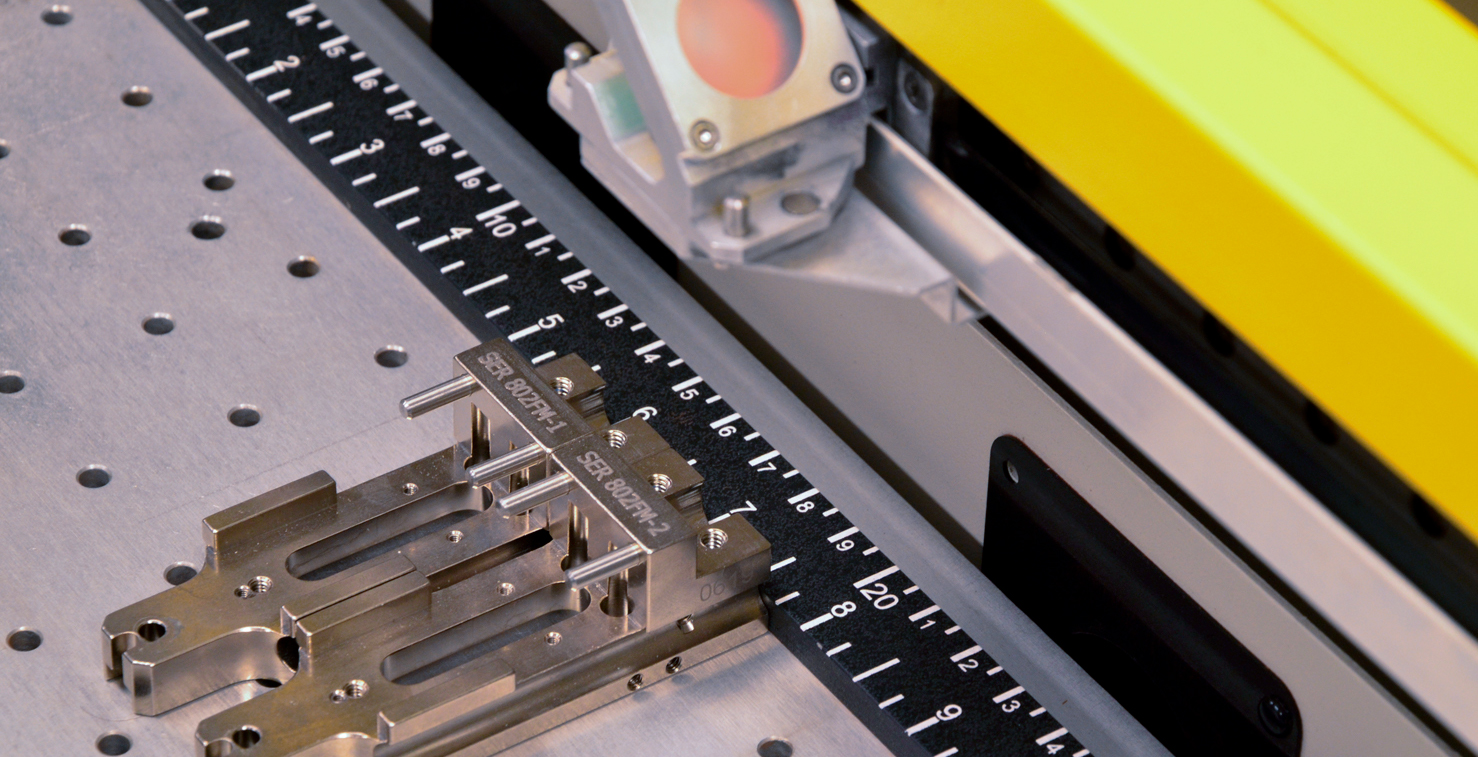 Lasers are an effective way to apply marks to parts of diverse shapes, sizes, and quantities. Source: Epilog
Lasers are an effective way to apply marks to parts of diverse shapes, sizes, and quantities.
3D printing has garnered a lot of attention over the last few years thanks to its ability to build virtually any type of device or product in an inexpensive manner. For a while, 3D printing was limited to the manufacturing of plastics, printing that material layer by layer. However, the technology has improved to where numerous companies have the capacity for 3D printing metal, concrete and other materials for applications such as replacement automotive parts, airplane wings, concrete bridges, full residential housing and much more. There are even farms of 3D printers being established that can run all day and night, having minimal interaction with human workers as they crank out devices and parts.
Robot use in factories has grown substantially over the past five years; they can now be found on factory floors, in manufacturing warehouses and in logistics. There’s currently an emphasis being placed on collaborative robots, or cobots, that work hand-in-hand with human workers toward a common goal. Some cobots are just mechanical arms that can be used for tasks such as welding or circuit board molding or connecting electronics; others are larger machines that can do heavy lifting or even cook food. A recent study by MIT showed that a robot working with a human in a factory is more efficient than just a singular robot or a singular human working alone. The study also found that this scenario reduced unproductivity by 85 percent. Smart factories are leaning toward the use of cobots to save humans from needing to perform dangerous or hazardous tasks, yet also preventing robots from entirely replacing the human workforce. While still in the early stages of adoption, cobots are expected to create disruptive opportunities in the manufacturing sector.
Laser engraving can create high-quality marks that can be easily read by barcode scanners, RFID scanner or other inventory-tracking tools.
 Laser engraving can create high-quality marks that can be easily read by barcode scanners, RFID scanner or other inventory-tracking tools. Source: Epilog
Meanwhile, the rising use of industrial lasers in manufacturing can be seen in applications such as laser material processing, laser micromachining, laser marking and laser engraving. Laser technology gives factories the ability to bring added value to the products they create. Examples include engraving custom names or logos; barcoding multiple products simultaneously; adding identification marks to prevent counterfeiting; and producing a variety of laser marks on a number of materials, such as bare metals, coated metals, anodized metals and plated metals. In each case, the work can be done with incredibly fine detail.
Laser engraving also helps to protect intellectual property thanks to its ability to add serial numbers, time stamps, part numbers, component labels, data matrix code markings, branding and industry-specific codes – in each case providing a high-quality mark that can be easily read by barcode scanners or other inventory-tracking tools that are vital to a smart factory. In addition, laser systems can be connected to a factory network as a manifestation of the IIoT, presenting new possibilities for system maintenance, monitoring, operation, remote troubleshooting and product support.
For more information on how to integrate laser cutting and engraving into your factory, fill out the form on this page or call us at the number below to discuss your application and to set up a demonstration with the distributor in your area.
Powered by CR4, the Engineering Community
Discussion – 0 comments
By posting a comment you confirm that you have read and accept our Posting Rules and Terms of Use.
-

Critical Technology Trends
The “cloud” has created unprecedented opportunities. But with so many new technologies, security concerns and supply chain uncertainty, where should you focus your resources for the next 10–20 years? The Technology experts at IHS discuss this and other trends in our latest white paper.
WHITE PAPER
Advertisement
Advertisement
Popular News
Find Free Electronics Datasheets

Advertisement