
A new blue light imaging method devised at the National Institute of Standards and Technology (NIST) can be a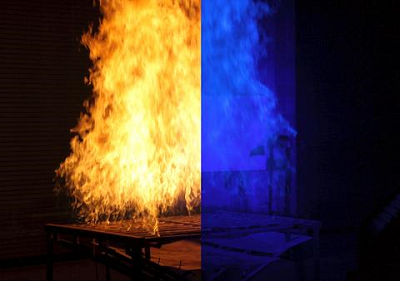 To improve the ability of researchers to "see" through fire, NIST has developed an imaging system using ordinary blue light to dramatically clear the picture. Source: National Fire Research Laboratory/NIST useful tool for obtaining visual data from large test fires where high temperatures could disable or destroy conventional electrical and mechanical sensors.
The technique combines narrow-spectrum, blue illumination and matched optical filters to reduce the influence of optical emissions from a glowing hot target and a large natural gas diffusion flame. Compared to white light, the required illumination to detect objects engulfed in flames with this method is reduced by a factor of 104.
Detailed information for researchers is generated by digital image correlation, a technique that compares successive images of an object as it deforms under the influence of applied forces such as strain or heat. By precisely measuring the movement of individual pixels from one image to the next, valuable insights are gleaned about how the material responds over time, including behaviors such as strain, displacement, deformation and the microscopic beginnings of failure.
Using low-soot, non-smoky gas fires in tests, the researchers observed that images were distorted by thermal gradients in the hot air, and obscured by the intensity of light emitted by flames.
Technology used in the glass and steel industries was applied to overcome these issues. These manufacturers deploy blue-light lasers to counter the red light emitted by hot materials that can undermine sensor accuracy.
Commercially available blue light-emitting diode lights with a narrow-spectrum wavelength around 450 nanometers were tested. To combat image distortion induced by the flames, the researchers averaged a number of single images together.
One trial examined how fire bends steel beams and another monitored what happens when partial combustion occurs, progressively charring a wooden panel. For both, the imaging was greatly improved.
