
Controlling flames could lead to greater energy efficiency and fewer harmful emissions from transport and industry. Flames contain charged ions and electrons that can be manipulated using electricity. KAUST researchers have produced the first detailed 3D visualizations of ionic winds flowing from a flame in response to both direct (DC) and alternating (AC) electric fields.
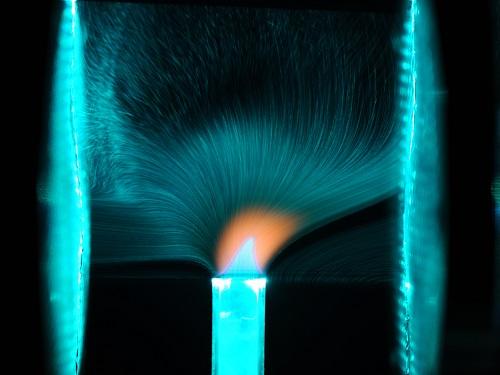 The researchers acquired incredible images, such as this one, showing a jet flame being affected by a 16-kilovolt electric field between two electrodes. Source: Minsuk Cha
Min Suk Cha and coworkers developed a theoretical model explaining how ions in a flame respond to electric fields. The researchers rejected a mixture of methane and air through a jet flame nozzle that is positioned between two electrodes. They then illuminated the flame using an argon-ion laser and detected the scattered light in order to trace the motion of individual particles through the flame. This technique is called particle image velocimetry or PIV. In order to improve the visualization, they had to add the flame reflective seeding particles made from titanium oxide and oil.
"The particle seeding to the ambient flame was quite difficult," said Cha. "We used a smoke generator, but we had to control the timing of the smoke generation very carefully so that we didn't disturb the main flow. It was a time-consuming step requiring a lot of patience."
The researchers acquired images that reveal unprecedented details of how flame dynamics respond to electricity. When they used a DC field, the flame visually bent towards the negative electrode because positive ions (which vastly outnumber negative ions in the flame) were attracted that way.
Counterintuitively the ionic wind blew toward the electrodes, which indicated an important role for negative ions. In an AC field, the ionic wind dynamics depended on the applied AC frequency, but only at low frequencies. The ionic winds could influence the combustion process by allowing a controlled redistribution of heat and combustion products by convection.
Cha hopes that the work will have a positive impact on the future design of flame-generating machinery. This technology wouldn’t require the building of completely new industrial equipment.
"The beauty of this method is that it can be retrofitted — it can be added in as an active control method for any pre-existing combustion system. Depending on the system configuration and the type of combustion that we need to control, we could use our knowledge and understanding to work out the appropriate locations of electrodes and choose the best operational parameters, such as voltage or frequency," said Cha.
A paper on this study was published in ScienceDirect.
