
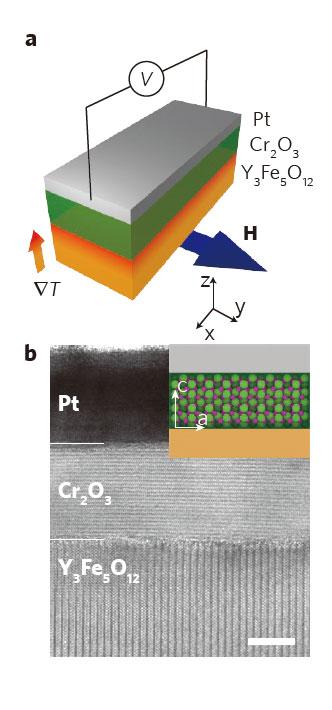
 Schematic illustration (top) and cross-sectional image of the tri-layer device used to create a spin current switch. Source: Nature Publishing Group
The emerging field of spintronics just got a boost from a mechanism created by researchers at Tohoku University in Japan.
Spintronics uses not only the charge of electrons, but also their “spin.” While detecting and generating that spin is within the reach of current technology, what’s been missing is a current switch — the equivalent of a transistor used in traditional electronics to enable and disable the flow of electricity.
Compared to the electronics of today, spintronics offers several advantages: less energy is required; power consumption is low; and manufacturing costs are reduced because no specialized semiconductor material is needed.
The new spin current switch relies on a layered material's structure: chromia (Cr2O3) between yttrium iron garnet (YIG) and platinum (Pt). The YIG/Pt pair is a standard combination of materials used to investigate the spin current flow; both are insulators in which electrons cannot flow. YIG generates spin current in response to RF microwave or temperature gradient, while Pt detects the spin current as an electric voltage through a mechanism known as the inverse spin hall effect (ISHE).
Using this set-up, the researchers were able to measure how much the chromia layer can transmit the spin current. They could also investigate the change of the voltage against the temperature and the applied magnetic field. They found that, at the temperature point where chromia changes its phase from paramagnet to anti-ferromagnet, the charge showed a massive reduction in voltage signal. By contrast, under the application of a magnetic field, nearly a 500 percent increase of spin current was transmitted.
These results suggest that the layered structure works as a spin current switch.
Professor Eiji Saitoh, one of the researchers, put it this way: "Just as the transistor revolutionized electronics by enabling the scalable development of electronic devices, the discovery of a spin current switch is likely to take spintronics in a new direction."
