
Duke University researchers have created a thin material that controls the redirection of soundwaves almost perfectly. This kind of material has been attempted before, but those materials have failed because they have been unable to control the transmission and reflection in the same way. Past attempts at this material have not been able to operate in an experimental setting.
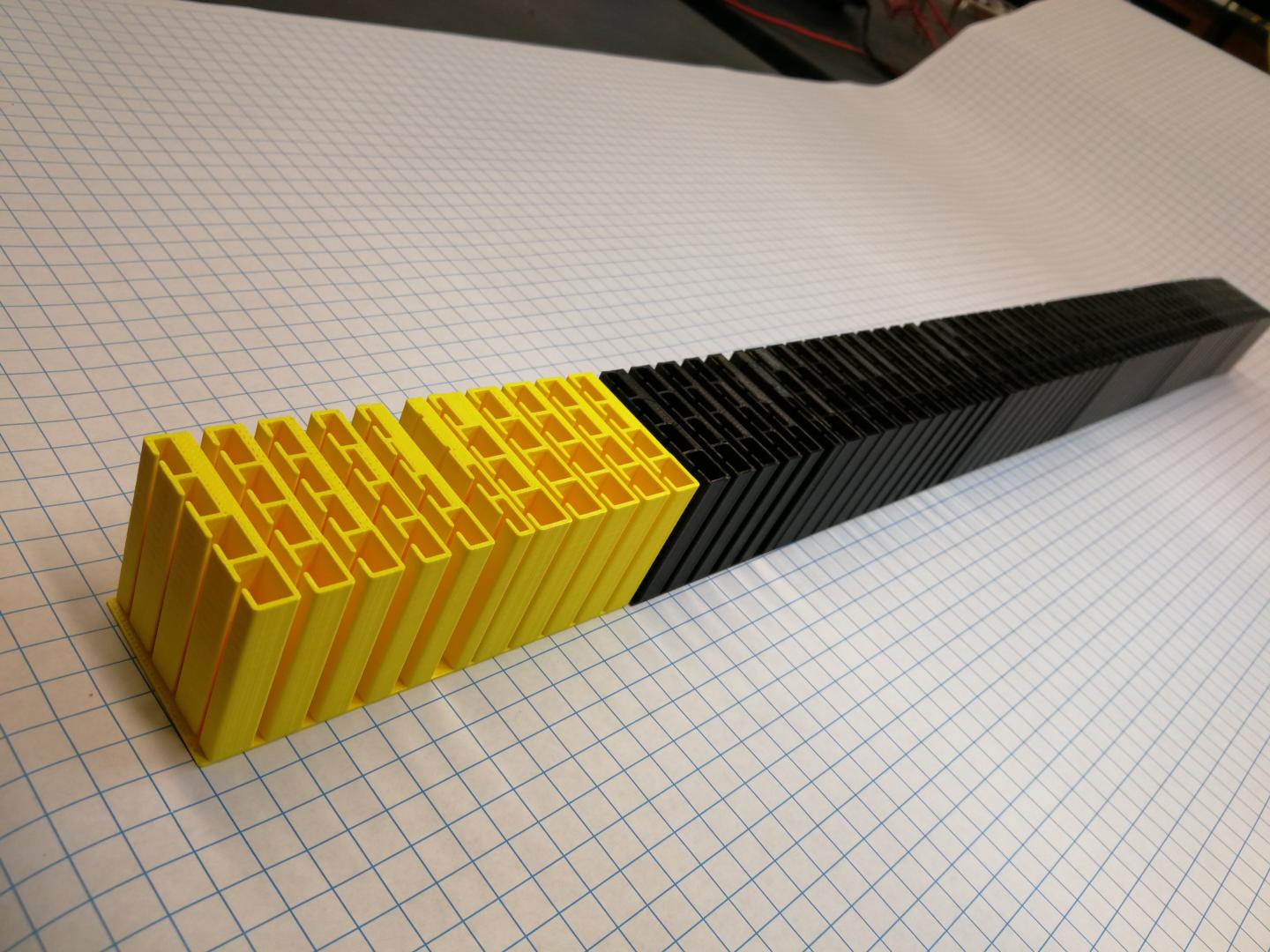 This metamaterial surface has been engineered to perfectly control the transmission and reflection of incoming sound waves. (Source: Junfei Li)
The newest design was able to operate in an experimental setting with near perfect control of sound waves. The material is 3D printed, making it quick and easy to create.
"Controlling the transmission and reflection of sound waves this way was a theoretical concept that did not have a path to implementation — nobody knew how to design a practical structure using these ideas," said Steve Cummer, professor of electrical and computer engineering at Duke. "We solved both of those problems. Not only did we figure out a way to design such a device, we could also make one and test it. And lo and behold, it actually works."
The new material is made of metamaterials — artificial materials that have the ability to manipulate sound and light waves through their structure. This particular material is created from 3D-printed plastic that is shaped just perfectly to manipulate sound waves. The metamaterial is a series of four hollow columns that are a 0.5 in. on each side and have a narrow opening cut down the middle of one side. The device used in the initial testing and in the paper is 1.6 in. tall and 3.5 ft. long, although the material could be any size.
The manipulation of sound is controlled by the width of the channels between the rows and the cavity size in all the columns. As sound waves travel through the device each cavity vibrates the sound at the frequency that is desired. The vibration affects the speed of the soundwave and how it interacts with the other cavities.
"Previous devices could shape and redirect sound waves by changing the speed of different sections of the wavefront, but there was always unwanted scattering," said Junfei Li, a doctoral student in Cummer's laboratory and first author of the paper. "You have to control both the phase and amplitude of both the transmission and reflection of the wave to approach perfect efficiencies."
The vibrating columns interact with the sound waves and the surrounding columns. Li says that to counteract this, they will need to develop an "evolutionary computer optimization program."
The program will be fed the boundary conditions that are needed for the material to command how they want the waves to behave. The researchers tested this with a random set of design solutions and the program mixed various combinations of the best solutions. Then random mutations were introduced and the numbers are run again. After a few rehearsals, the program evolved a set of design parameters that created the result that the researchers were looking for.
The next step for the research team is to develop this material to operate underwater for uses in sonar, and then attempting to figure out a use for it in the air.
"When talking about waves, I often fall back on the analog of an optical lens," said Cummer. "If you tried to make really thin eyeglasses using the same approaches that these sorts of devices have been using for sound, they would stink. This demonstration now allows us to manipulate sound waves extremely accurately, like a lens for sound that would be way better than previously possible."
The paper on this research was published in Nature Communications.
