
The team created a hybrid tree that is made of natural and artificial leaves. Both kinds of leaves act like a green electrical generator that allows the plant to convert wind into electricity.
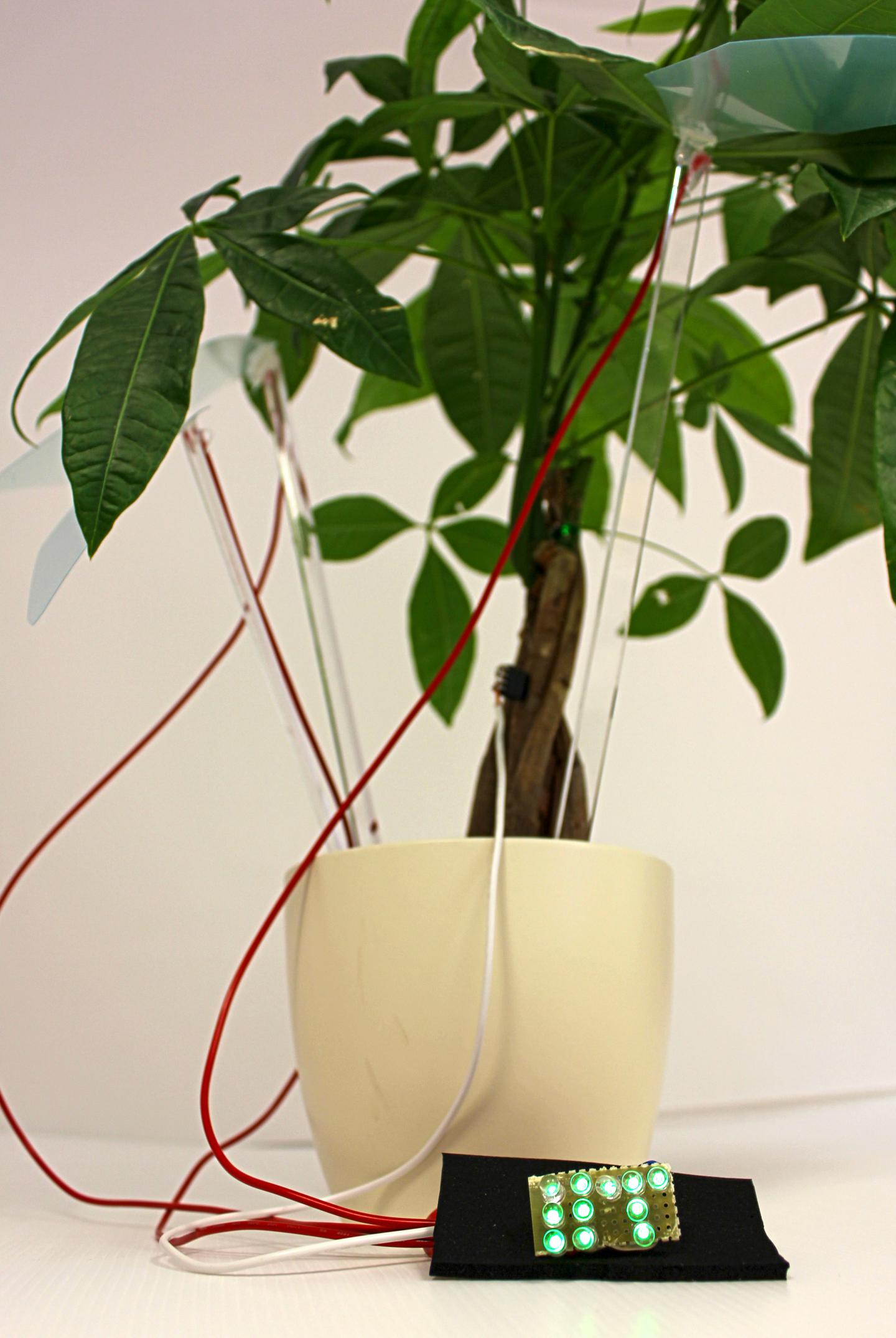 The hybrid plant is made of natural and artificial leaves. When wind blows into the plant and moves the leaves, the 'hybrid tree' produces electricity. (Source: IIT-Istituto Italiano di Tecnologia)
When creating this system, the team took a deeper look into plant leaf structure.
During the literature review, it was found that leaves can create electricity when they are touched by a special material or moved by the wind.
There are leaf structures that can convert mechanical forces that are applied to the leaf’s surface into electrical energy. The cuticle in leaves is dielectric and the adjacent cellular tissues are also conductive.
The leaves gather electrical changes created on the surface by triboelectricity. Triboelectricity is an electrical charge that is generated when two materials touch and separate. When the leaves separate, the electrical charge is generated and released.
The changes on the leaf’s cuticle are transmitted into the inner plant tissue. This tissue acts as a “cable,” transporting electricity to other parts of the plant, like the stem. The stem acts as the “plug,” where the electricity can be harvested and used to power electronics.
After developing this method, the team needed to create a prototype for the wind-generated electricity system. Earlier research at Iowa State University showed that a so-called tree with artificial leaves generates electricity from the mechanical force of the wind. The Italian research team demonstrated that wind power can create electricity with natural as well as artificial leaves. They modified a Nerum oleander tree with a few artificial leaves that touch the plant’s real leaves. When wind moved the plant’s leaves, the tree generated electricity. The more that the leaves moved, the more electricity was generated. The team says that this system could be scaled up to cover a whole forest. This study was part of a larger project that the team is working on to create bio-inspired robots, called Growbots. The results of this study have been published in Advanced Functional Materials.
