
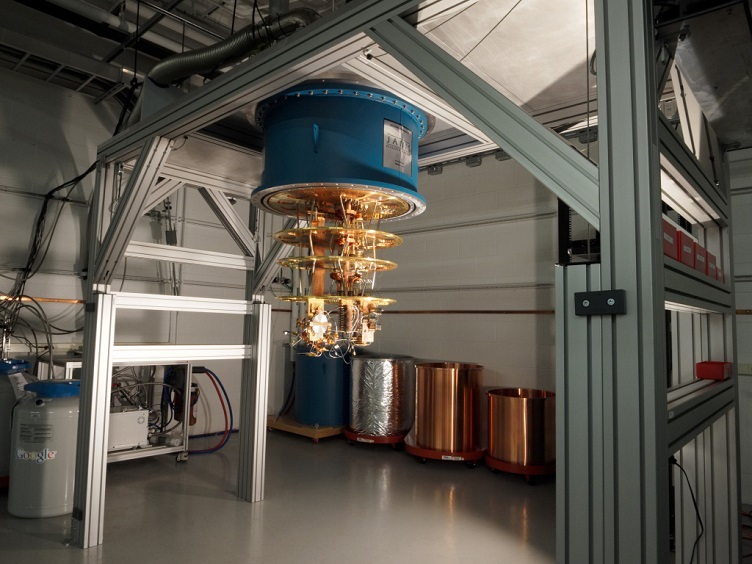
In order to build the future of mobility, Daimler has signed a cooperation agreement with Google to research future applications for quantum computers.
Google recently designed a 72-qubit Bristlecone chip featuring the highest number of quantum bits ever used. Qubits are the smallest possible unit of data storage and serve as a unit of measurement denoting the performance capability of quantum computers.
The cooperation agreement allows teams from Daimler Group Research and IT to use quantum computers from Google to pursue issues relating to the future of mobility.
"Quantum computing could play a crucial role in future in developing sustainable and efficient mobility solutions, as well as in diverse applications within our company," says Jan Brecht, CIO at Daimler. "Quantum computing has the potential to revolutionize the entire IT sector and, in turn, all other areas of industry. This technology is as yet still in the early stages of research and development — but it harbors vast potential. Our aim is to acquire experience with this new technology at an early stage. To this end, we are contributing concrete use cases from the automotive and mobility fields to the research partnerships."
Unlike present-day computers, quantum computers do not operate solely in a binary numeral system but also knows other states — so-called superpositions. These vastly expand the scope of computing capabilities, enabling complex calculations to be performed at super speeds.
Quantum computers in terms of mobility could be used to:
- Create new materials for quantum chemistry and the development of new battery cells.
- How autonomous vehicles can be deployed in urban environments and mega cities, relieving the strain on the transport infrastructure.
- Logistics planning in vans.
- Production planning and production process optimization.
- Deep learning advancements in artificial intelligence.
