
As a control for an engineered system, a switch is a pretty invaluable tool: mechanical switches are used to select gears in a car’s transmission; electrical switches turn the lights in a room on and off; semiconductors uses switches (transistors) to route logic signals within a circuit.
Engineers have long desired a switch to control heat flows, which could significantly improve system performance and reliability in electronics systems. Many challenges exist in the creation of such a switch — but researchers from the College of Engineering at the University of Illinois at Urbana-Champaign have developed a new technology that appears to do the trick.
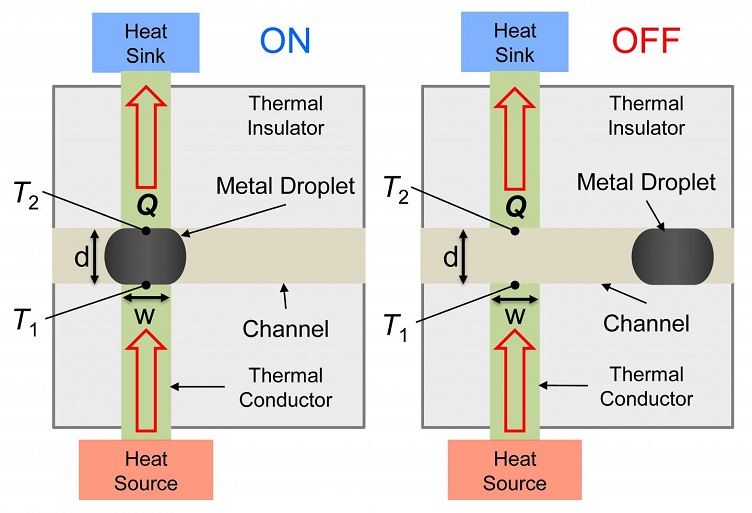
"Heat flow occurs whenever you have a region of higher temperature near a region of lower temperature," notes William King, a mechanical science and engineering professor who served as a project co-leader. "In order to control the heat flow, we engineered a specific heat flow path between the hot region and cold region, and then created a way to break the heat flow path when desired."
"The technology is based on the motion of a liquid metal droplet," adds Nenad Miljkovic, assistant professor in the same department who also served as a project co-leader. "The metal droplet can be positioned to connect a heat flow path, or moved away from the heat flow path in order to limit the heat flow."
The technology was demonstrated in a system modeled after modern electronics: On one side of the switch was a heat source representing the power electronics component; on the other, liquid cooling for heat removal. When the switch was on, heat could be extracted at more than 10 watts per square centimeter. When the switch was off, heat flow dropped by a factor of nearly one hundred fold.
According to King, the next step for the research will be to integrate the switch with power electronics on a circuit board. A working prototype will be produced later this year.
The research was published in a recent edition of the journal Applied Physics Letters.
