
Efforts to assemble a DNA detection device were not going well for University of Rochester and University of Ottawa, Canada researchers. Design plans called for welding a microchip containing a nanofilter on top of a DNA sensor-equipped microchip.
The chips were not fitting together to make sufficient contact, causing one scientist to look over the top of his microscope and exhale in frustration.
That respiratory action proved to be the key: exhaled water vapor condensed on the device and enabled the 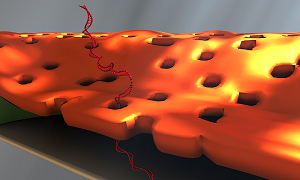 Doctoral student Greg Madejski's illustration of the layers comprising his new DNA detection device. University of Rochester illustration / Greg Madejskinanofilter to adhere to the sensor.
“It was like a really high-tech temporary tattoo that I created by accident; lick and stick!” said the University of Rochester Ph.D. student Greg Madejski.
The arrangement of three ultrathin layers forms a nanocavity filled with less than a femtoliter of fluid — or about a million times smaller than the smallest raindrops. A nanoporous silicon nitride membrane serves as a prefilter for a biosensor membrane with a single nanopore. A spacer layer separates these elements by 200 nanometers.
An electric field prompts a strand of DNA to enter one of the pores of the prefilter and then pass through the nanocavity to reach the pore of the underlying sensor membrane. This triggers changes in the device’s electrical current that can be detected and analyzed. DNA must elongate itself in a consistent way to pass through the two-membrane combination, improving the precision and reproducibility of detection.
The method of fabrication instantly wets the nanocavity, which is often difficult at the nanoscale. The device contains dozens of these nanocavities, which may eventually increase the amount of material that can be screened by enabling parallelized biomarker detection.
The prefilter in the new device addresses a problem with other silicon nanopore detectors: They are more likely to clog than alternative devices using biological pores for sensing. Biological membranes, on the other hand, are less stable than solid-state nanopores.
A second generation of the new device, developed at University of Rochester startup SiMPore, incorporates the prefilter right on the chips during manufacturing at the wafer scale, “so there’s nobody breathing on it anymore,” said James McGrath, professor of biomedical engineering. “It’s actually all built as one unit and should make future studies very easy. That’s a credit to the ingenuity at SiMPore and quite a legacy for Greg.”
